0. Prologue: The Oikumene, the Silence and the Reawakening
I. The Oikumene
Once, the galaxy was one.
The Progenitors, the first and greatest of the peoples, joined ten thousand worlds into a single civilization. They did it with light, not conquest. They built the warp lanes, ancient engines that folded the Abyss until every star was a neighbor, and for an age knowledge, art and trade flowed along them.
They called it the Oikumene: the inhabited whole.
II. The Silence
Then the stars began to die.
Whole systems detonated, struck by no weapon anyone could name, and as each one fell the lanes anchored to it went dark. Within a generation the web had come apart. The Progenitors never answered a single call. They were gone.
The galaxy broke into a thousand islands of light, each one alone. That age is remembered as the Silence.
III. Three Thousand Years Alone
Cut off from the lanes, the survivors went hungry for food and fuel, and most of all for each other.
Three thousand years of isolation wore the heirs of the Oikumene down and remade them. They adapted, diverged and forgot. The Progenitors faded from history into myth and from myth into superstition. Their ruins still sit in the crust of colony worlds and drift cold between the stars, running on mathematics nobody alive can fully read.
Eight peoples came through. Each has its own answer to the same question: what caused the Silence, and how do we stop it happening again? Each is sure the other seven are wrong.
IV. The Reawakening
Now, for reasons nobody understands, the ancient machines are waking.
Dormant gateways flicker with light for the first time in three millennia. The lanes are weak and unstable, but they are there, and the map of the galaxy is being redrawn one corridor at a time.
Between the lanes lies the Abyss: unmapped and unlit. Ships can cross it. Some of them come back.
The region where the old lattice broke worst, where corridors end in empty space, is now charted as the Shattered Axis.
V. Your Command
You start with a homeworld, a few ships and one starbase at the edge of your home system. Your rivals woke to the same reopening dark, and they are already moving.
The Progenitors left ruins all over the Shattered Axis. You will find them, and so will your enemies. Some will make you rich. Some will make your name. A few are still awake, and have been waiting a long time for someone to knock.
Whoever masters the lanes again will inherit the new age.
1. Welcome, Commander
1.1 What kind of game is this?
Axis and Abyss is a simultaneous-turn 4X strategy game that runs in your browser. Every commander gives orders for the same turn. When the turn resolves, the engine runs every phase in one pass:
Economy → Build → Research → Movement → Combat → Orbital Ops → Colonization → AI → Events → Cleanup
Your orders lock when you press READY, and everyone's orders resolve together.
The game is built for asynchronous multiplayer: 2 to 8 commanders, with AI empires filling the empty seats. The host picks the length when creating the game: Short (70 turns), Standard (200) or Epic (300). A turn can take five minutes to plan, and you can come back to the next one tomorrow.
1.2 The turn cycle
A turn resolves when either of these happens:
- Every commander has pressed READY, or
- The turn deadline runs out. The host sets the timer when creating the game; 24 hours is common. The
⏱ AUTO-RESOLVEchip beside the READY button counts down to it.
You do not need to be online when a turn resolves. If you fall behind:
- After 3 missed turns in a row, the AI takes over your seat so the game keeps moving.
- Issue any order and the seat is yours again. No menu is needed.
- Going away on purpose? Use the AI SETTINGS panel to hand your seat to the AI, and take it back when you return.
1.3 Your first turns
- Sign in and pick an empire. Each of the eight houses has its own ships, bonuses and play style (§2).
- Find your homeworld. It is always habitable and starts with a small defense force and a starbase in orbit. There is always at least one world with a native people within 300 units of it.
- Open the shipyard. Click your homeworld, open the Starbase tab, then Shipyard → OPEN SHIPYARD. Build a scout first. Scouts find colony sites and reveal your neighbors, and you will want several.
- Queue a colony ship. For several houses the colony ship is a freighter-class hull, so read the hull descriptions in the shipyard rather than going by the name.
- Check the Infra tab. Your homeworld starts with mines, logistics hubs and a few defense posts. Watch the ⚙ Maintenance/Turn row: everything you own costs upkeep every turn.
- Set the tax rate. Tax is set per planet, from 0% to 20%, and starts at 10%. Higher tax brings in more Solars and lowers happiness, and low happiness leads to unrest (§5). The game never changes your tax rate for you.
- Press READY.
1.4 The screen at a glance
| Region | Shows |
|---|---|
| Top bar | A status line (turn, Solars, Data Cores, planet and ship counts), then all six resources |
| Top-bar menus | Research · Diplomacy · Espionage · Trade · Fleets 🚀 · Captains · Subspace Comms · Tactical. Anomalies appears when a discovery is waiting; Psionic Scan appears for the Psionic Covenant only |
| Navigation drawer | Your planets, starbases and ships. It slides out from the left edge: tap the NAV arrow tab to open it and again to tuck it away. Click any entry to center the camera on it |
| Main map | The galaxy. Left-click to select, right-click to order a move, shift+click to force an Abyss jump |
| Detail panel | Whatever you selected. Planets show Overview / Starbase / Resources / Infra / Queue (plus Anomaly when there is one); ships show Overview / Cargo / Orders |
| Bottom bar | Cursor coordinates, READY and the ready count, the auto-resolve countdown, a reminder of unfinished work, Options, the ? help toggle and Logout. The host also sees END TURN |
Close any window with its red × or the Esc key.
On a phone the top bar becomes a row of icon buttons with the resources underneath, a strip along the bottom keeps your turn, Solars and READY button in reach, and the navigation drawer starts tucked away so the map is clear. Planet and ship panels fill the screen below the top bar.
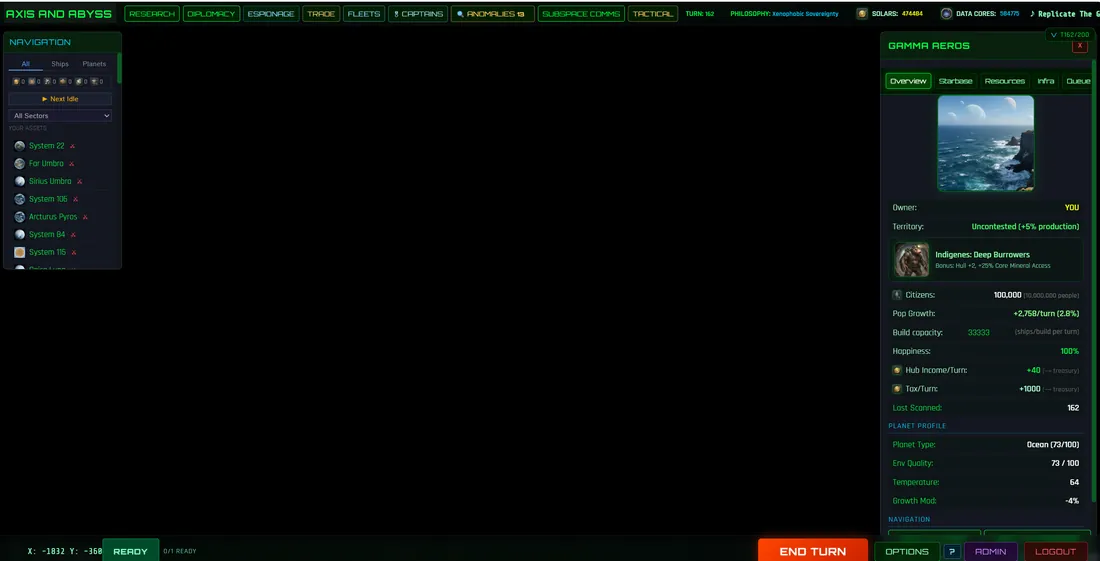
The command interface: navigation at left, the galaxy map at center, the detail panel at right.

The top bar carries your treasury, your research pool and every major panel in the game.
1.5 Playing on Steam or itch.io
Axis and Abyss is free to play in a browser at play.axisandabyss.com, and that will not change. The Commander's Edition is a paid desktop build on Steam and itch.io. It installs the game's art, music and video on your computer so they load from disk, and it includes four months of Admiral (§21.1):
- Steam: granted automatically the first time you launch the game from Steam while signed in.
- itch.io: open the Admiral window and enter your itch download key (the key itself, or the download page link). Each key works once.
Turns still resolve on the server, so you need an internet connection, and it is the same account and the same games as in the browser. Sign in the way you always do. If you signed up with Google, use Forgot access code once to set a password, because the desktop window cannot complete a Google sign-in.
2. The Eight Houses
Each house is a doctrine: a set of bonuses, its own ship line, its own Golden Age trigger and its own answer to the Silence. Pick the one that fits how you like to play.
All values below are the live numbers from the current build.
Cybernetic Collective: The Consuming Network

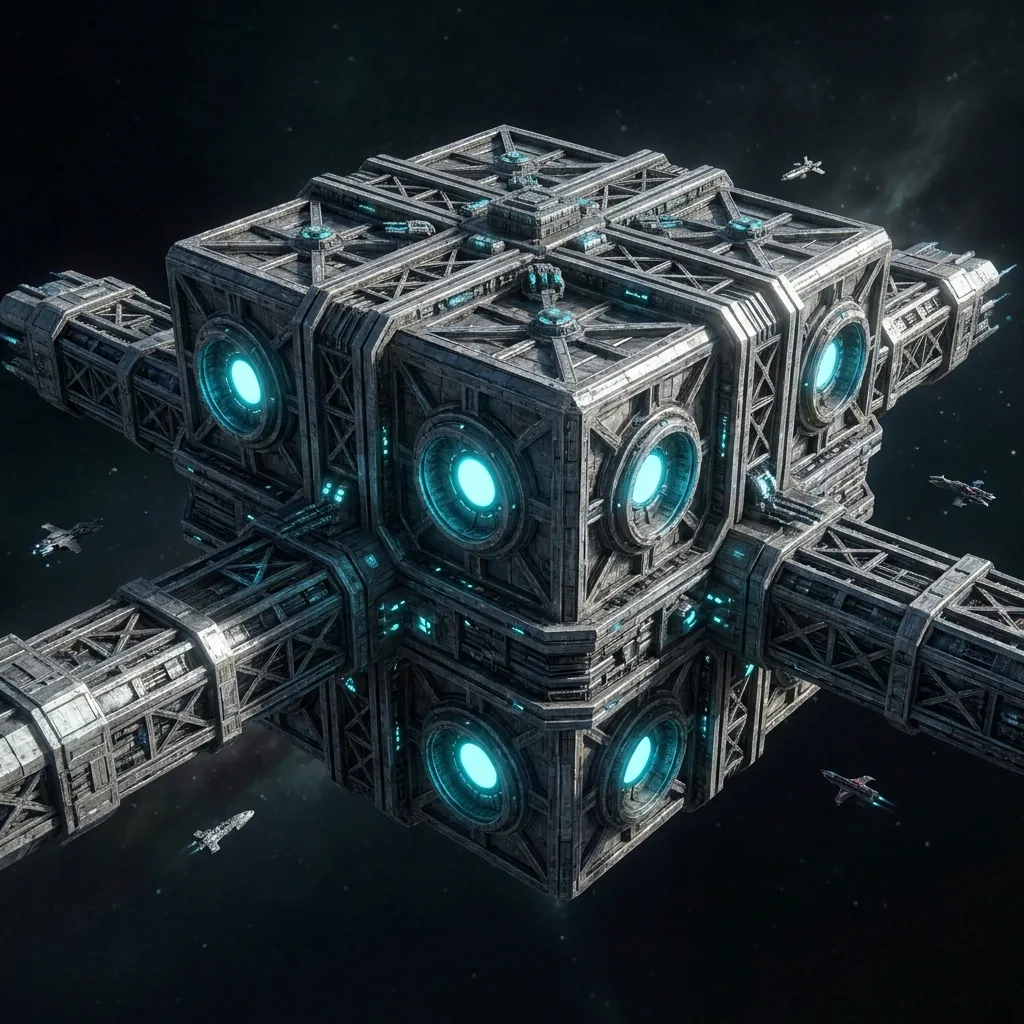
The Cybernetic Collective and their flagship, the Hive Nexus.
"Every mind is data. Every ship is a node. We have been assembling ourselves for centuries; you are merely another component."
| Prime stat | Technology |
| Bonuses | +10% mining · +20% research |
| Special | Assimilation: when the Collective wins a battle, each enemy ship destroyed has a 25% chance to rejoin as a Collective ship at 30% hull |
| Unrest doctrine | Unrest builds 20% more slowly; the Collective's "Reformat" resolution leaves no atrocity stain |
| Golden Age | Data Cores at least 1.5 × the sum of your Hull, Engine, Beam and Torpedo levels |
| Plays like | A slow starter that compounds. You trail early and pull ahead later. |
Bio-Engineered Armada: The Living Fleet

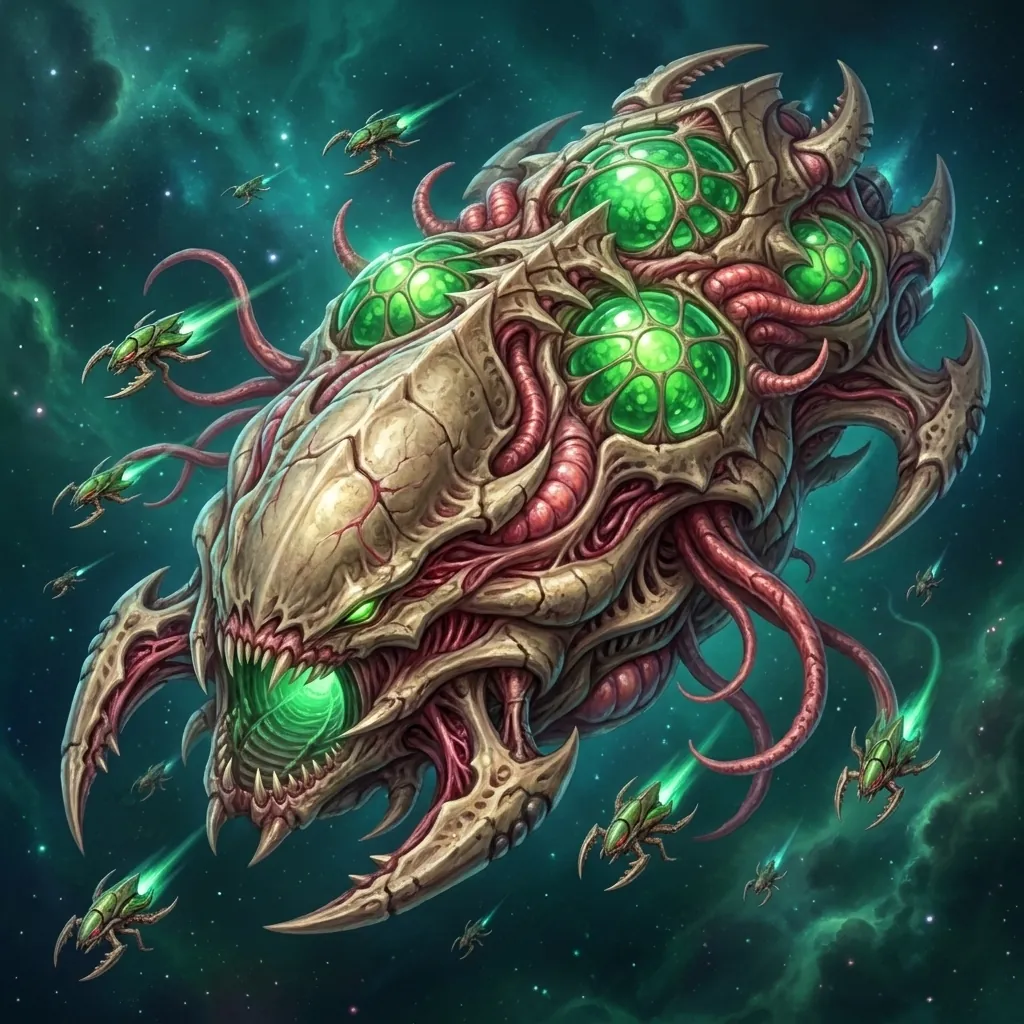
The Bio-Engineered Armada and their flagship, the Leviathan.
"Our ships are not built. They are fed, bred, and released."
| Prime stat | Combat |
| Bonuses | +15% combat damage · +10% population growth · 5% hull regeneration per turn |
| Special | Adaptive Hull: ships heal between battles without a dry dock |
| Unrest doctrine | +1 unrest per turn on worlds whose natives are not your own kind |
| Golden Age | Any weapon or defense discipline at tech 8 or higher |
| Plays like | Early, constant aggression. Your fleet heals between fights and theirs does not. |
Xenophobic Sovereignty: The Fortress Imperium

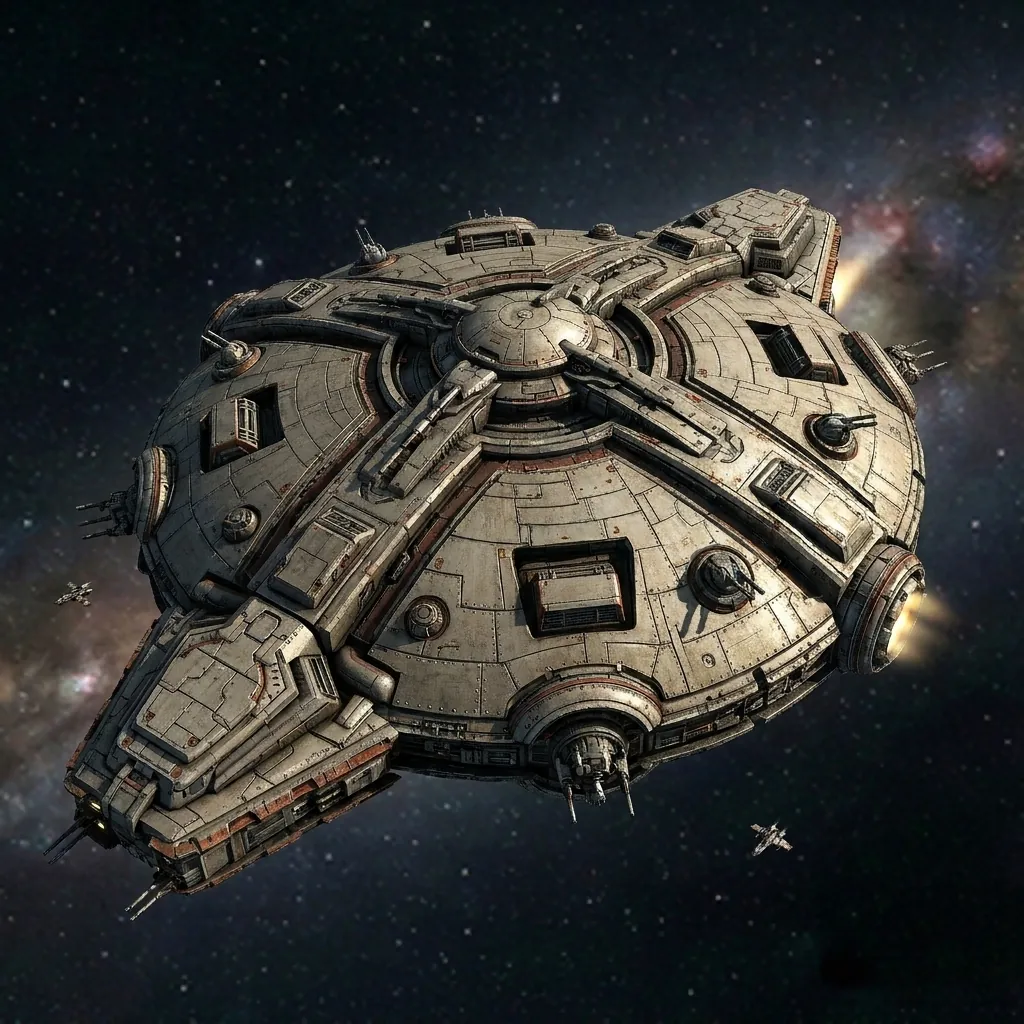
The Xenophobic Sovereignty and their flagship, the Sovereign Class.
"The Abyss has taught us one lesson: anything outside the wall eventually tries to come in."
| Prime stat | Defense |
| Bonuses | +50% planetary defense · starts with 10 extra defense posts · borders reach 50% further, and the combat and shield bonuses for fighting inside them are doubled |
| Special | Fortress Worlds: defense posts fight as full combat units. The Purge Lander troop ship (§6.4) makes invasions cheaper |
| Unrest doctrine | Iron Fist keeps 20% more of the population; +2 unrest on subject-race worlds; reform takes twice as long |
| Golden Age | Repel an invasion of 5 or more enemy ships |
| Plays like | The fortress. You expand slowly, and every world you hold is expensive to attack. |
Psionic Covenant: The Prophecy

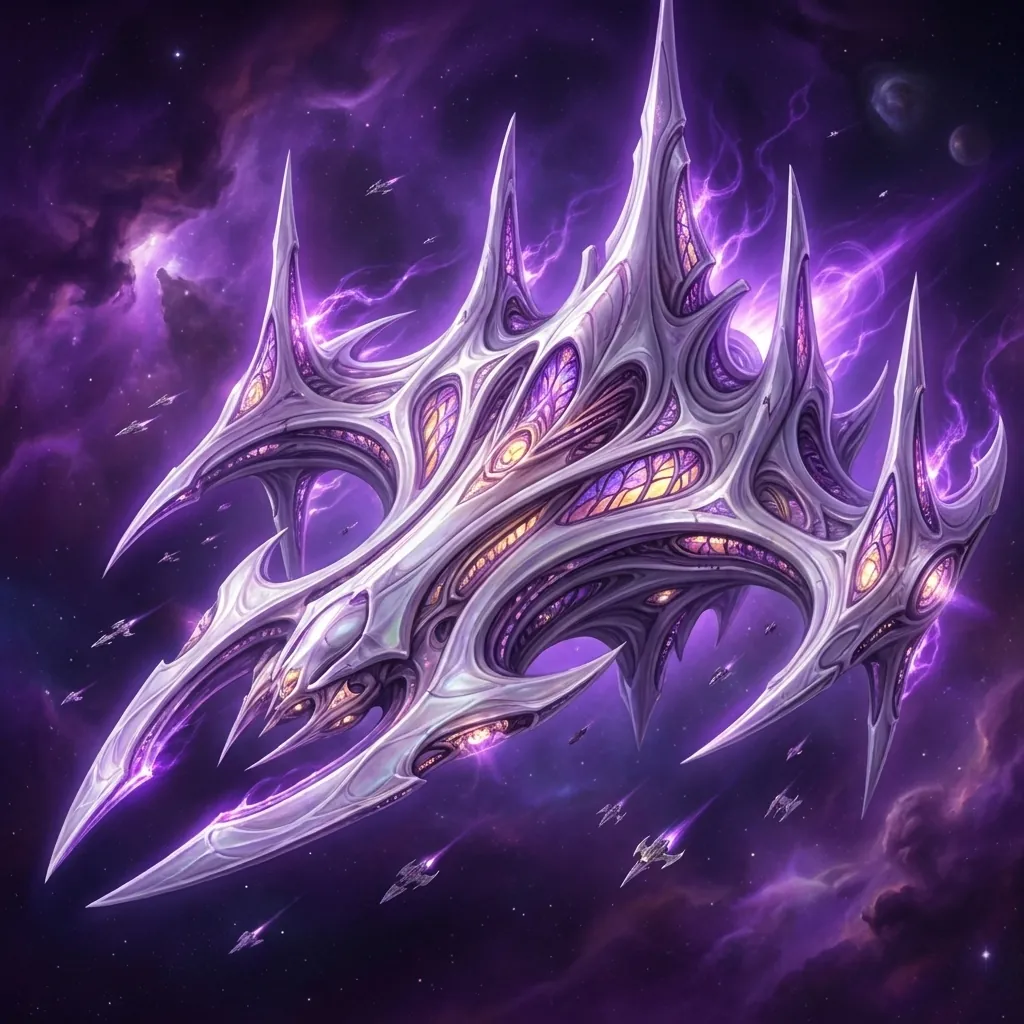
The Psionic Covenant and their flagship, the Cathedral of the Abyss.
"We foresaw the Silence. They called us mad, and then they died. We have been listening ever since."
| Prime stat | Intelligence |
| Bonuses | +50% sensor range · +20% espionage success |
| Special | Mind Link: in battle, each Psionic ship lowers one enemy ship's evasion by 5%. Psionic Scan shows where enemy fleets in sensor range are heading. The Veilrunner scout (§6.4) phases through space |
| Unrest doctrine | Sees unrest one stage early; can research Psionic Calm (×0.7 unrest build-up on every world) |
| Golden Age | Complete the Prophecy chain, a multi-stage story arc |
| Plays like | An information game. You see first, you know where their fleets are going, and you take their tech. |
Merchant Conglomerate: The Counting House

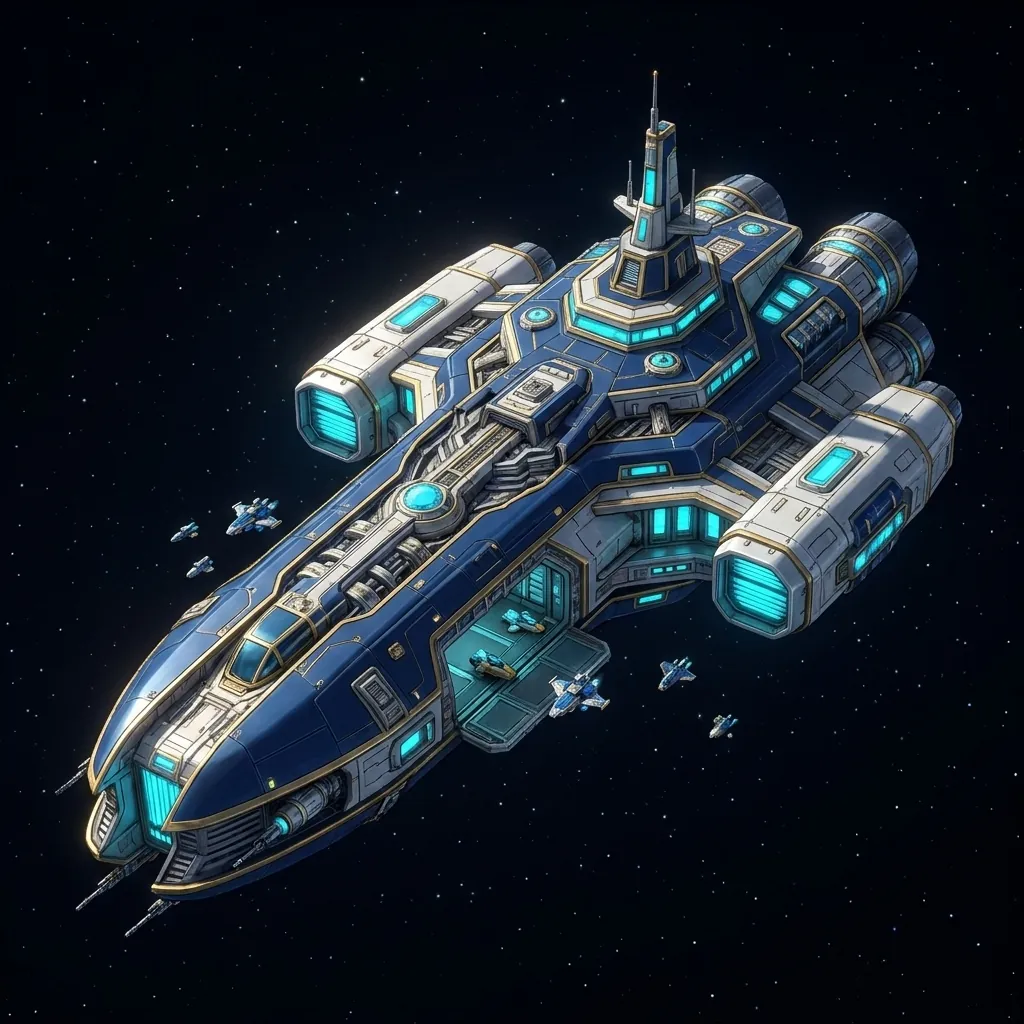
The Merchant Conglomerate and their flagship, the Logistics Hub.
"Wars end. The best contracts do not."
| Prime stat | Economy |
| Bonuses | +20% tax income · +25% trade-route income · +15 Solars per paying trade route · 15% off market purchases · starts with 5,000 extra Solars |
| Special | Trade Lanes: trade routes keep paying even from a world in Riots |
| Unrest doctrine | Velvet Glove costs half |
| Golden Age | Hold 50,000 Solars |
| Plays like | The economic engine. Trade and tax pay for a large fleet and fast research, which is how a Merchant climbs the Score, and a full treasury takes the top of the wealth podium (§20.1). |
Nomadic Wanderers: The Caravan

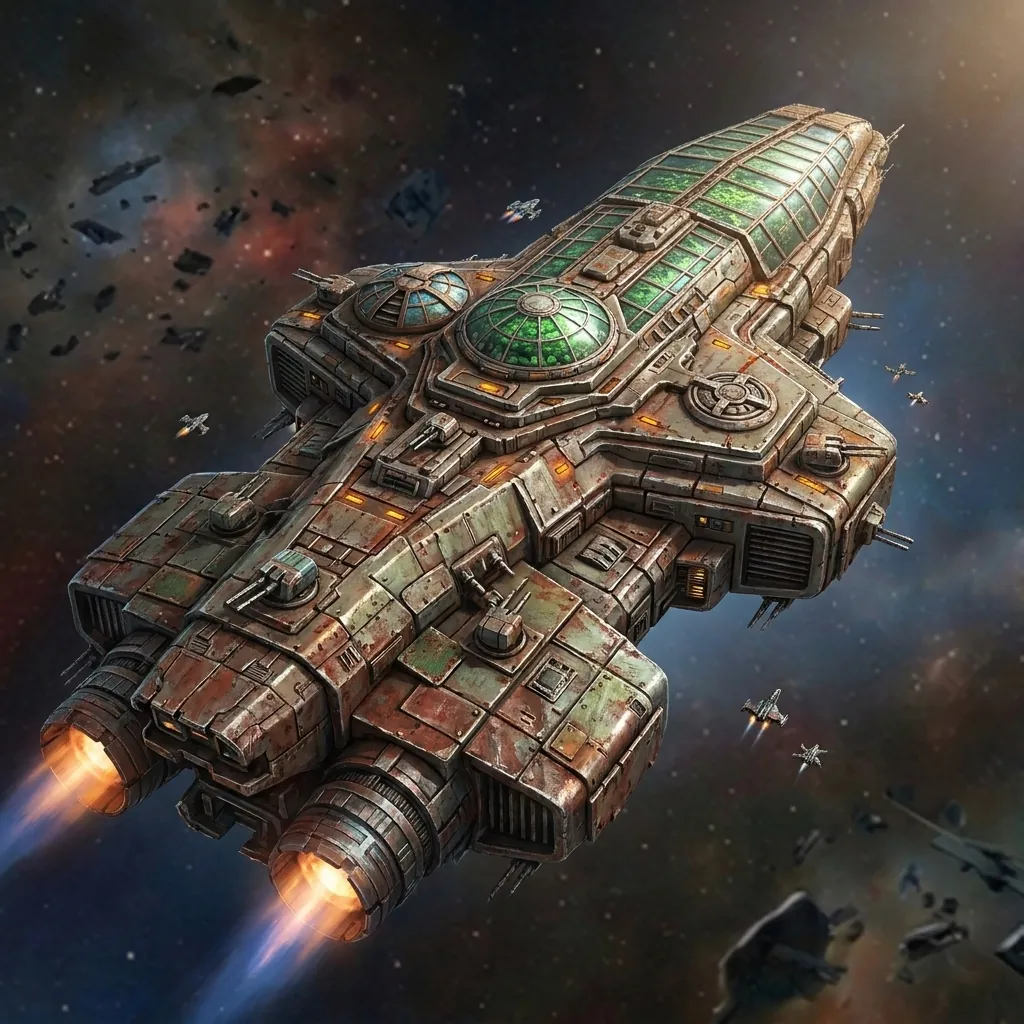
The Nomadic Wanderers and their flagship, the Mothership.
"A planet is a chain. A fleet is a promise to the horizon."
| Prime stat | Mobility |
| Bonuses | 20% less fuel use · +20% cargo capacity · half damage in the Abyss |
| Special | Fleet Logistics: the Mothership is a mobile shipyard that can build and refit ships away from any starbase |
| Unrest doctrine | Unrest builds 50% more slowly; granting Independence gives you 2 free ships |
| Golden Age | Hold an active Defense Alliance |
| Plays like | Raiders. You cross the Abyss where other fleets would not survive the trip. |
Robotic Dominion: The Rebooted Foundry

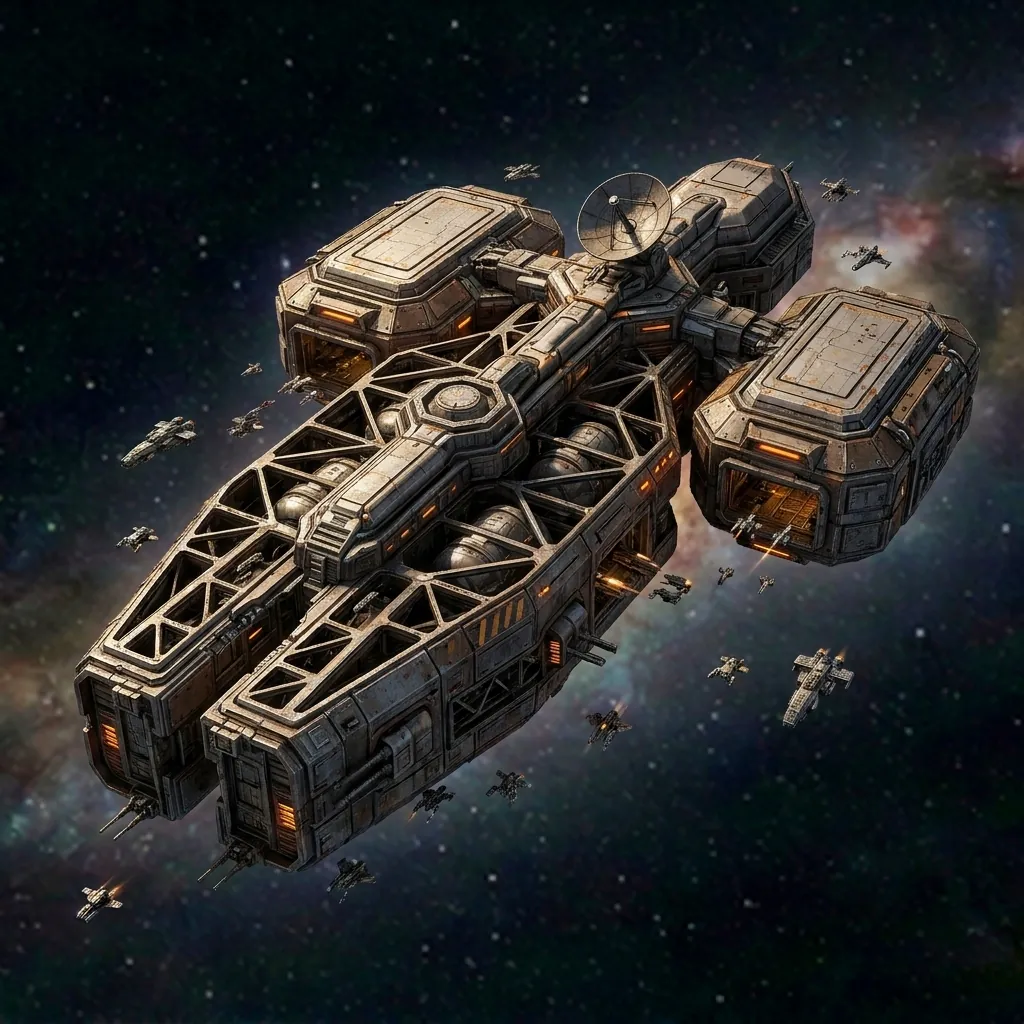
The Robotic Dominion and their flagship, the Drone Host.
"We were built by a species that no longer exists. We have been building ever since."
| Prime stat | Production |
| Bonuses | +20% production · 10% hull regeneration in friendly space · half price on base maintenance |
| Special | Automated Repair: ships repair themselves in any system you own |
| Unrest doctrine | Zero unrest on worlds of your own kind; unrest builds 1.5 × as fast on conquered biological worlds |
| Golden Age | Hold 15 or more planets |
| Plays like | Mass production. Cheap upkeep lets you run far more infrastructure than anyone else. |
Technological Pioneers: The Long Scholars

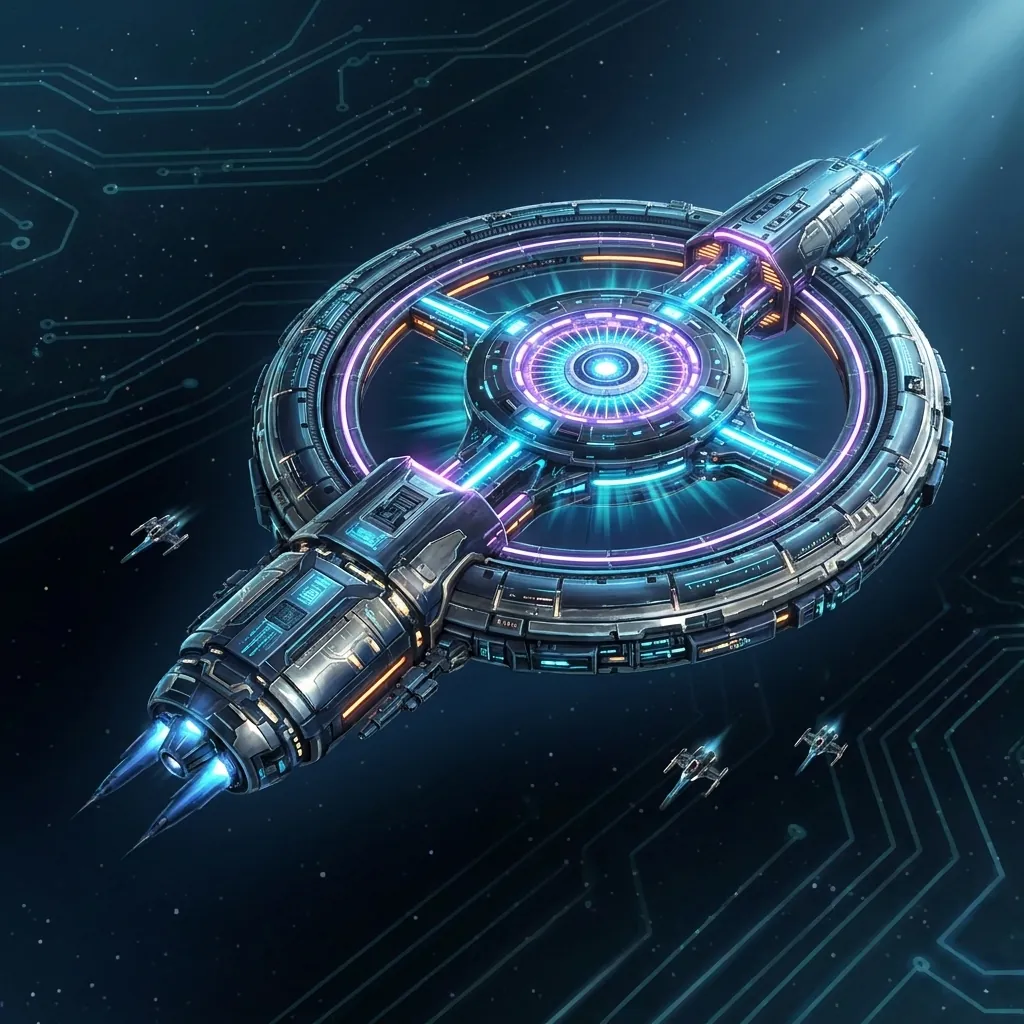
The Technological Pioneers and their flagship, the Singularity Lab.
"For three thousand years we researched. Now we get to apply it."
| Prime stat | Research |
| Bonuses | +25% research speed · +25% sensor range · cheaper high-tier research |
| Special | Long Scholars: the best research economy in the game |
| Unrest doctrine | Constitutional reform ratifies 25% faster; Political Science costs half |
| Golden Age | Total tech across all lines of 30 or more |
| Plays like | The tech race. Weak early, dangerous late. |
3. The Six Currencies of Power
| Resource | Comes from | Buys |
|---|---|---|
 Solars Solars |
Tax, logistics hubs, trade routes, gifts | Ships, buildings, research, upkeep |
 Isotopes Isotopes |
Mined from isotope-rich worlds | Ship fuel. Stored in the hull and burned on every move |
 Alloys Alloys |
Mining | Hulls, starbases, defense posts |
 Composites Composites |
Mining | Advanced hulls, modules |
 Rare Earths Rare Earths |
A few scarce worlds | High-tier weapons and modules |
 Logistics Logistics |
Logistics hubs | Construction and station operations |
The six currencies.
Solars and Data Cores are empire-wide. Minerals and Logistics stay on the planet that produced them. Move them with freighters or supply routes (§9.6) when another world needs them.
3.1 Upkeep
Everything you own costs something every turn, charged in the Economy phase. A planet's Infra tab shows ⚙ Maintenance/Turn, with the full breakdown on hover.
Ships pay base maintenance of roughly mass ÷ 10 Solars a turn, plus a flat fleet command tax of 12 Solars per ship. Ships heavier than 300 mass also draw 1 Logistics per 300 mass. A ship outside your supply range pays double maintenance.
Buildings: mines, hubs, labs, posts and starbases each draw Solars, Logistics or both.
The Robotic Dominion pays half the base maintenance. The fleet command tax and the Logistics draw are not discounted.
Imperial Overhead applies to very large surpluses: when your net Solar income rises well above a threshold that grows with your empire, part of the excess is skimmed off. Small and mid-size empires never reach it. It keeps a runaway leader from simply banking the game, so spend your income.
Blockades: an enemy warship in orbit cuts that world's tax and hub income to 75%.
Rule of thumb: keep income at about 1.5 × upkeep. At parity you have nothing left to answer a war with.
4. Planets & Infrastructure
Planets are the only lasting asset you own. Fleets get destroyed and treasuries get spent; your worlds stay.
4.1 Reading a world
Every planet has an environment class (Gaia, Continental, Ocean, Arctic, Desert, Tundra, Barren and others), a temperature, a maximum population and four mineral densities (isotopes, alloys, composites, rare earths). The Tactical menu can paint each density across the map.









Environment classes. A world's class sets its population ceiling and its mineral character.
Some worlds have a native people. See §13.
4.2 What a planet produces
Each turn, every planet you own produces:
- Tax Solars: citizens × tax rate × happiness, adjusted by your house's tax bonus
- Solars and Logistics from logistics hubs
- Minerals from mines, scaled by density. Mines draw down a finite core reserve; isotopes slowly regenerate
- Data Cores from data core facilities, paid into your empire research pool
4.3 What you can build
| Building | Purpose | Cap per planet |
|---|---|---|
| Mining Hub | Extracts minerals by density | 1 per 150 citizens |
| Logistics Hub | Solars and Logistics | 1 per 100 citizens |
| Data Core Facility | Research output | 1 per 1,000 citizens |
| Defense Post | Planetary defense; fires in orbital combat | 1 per 150 citizens, capped by Orbital Defense tech at 10 / 15 / 20 / 25; no world holds more than 25 |
| Entertainment Complex | +5 to the happiness level the world settles at, and 1 less unrest gained per turn, per complex | 2 (the second needs 1,000 citizens) |
| Starbase | Shipyard, tech caps, modules, supply hub | 1 |
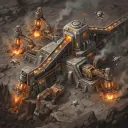

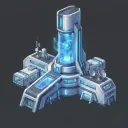
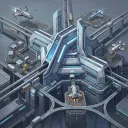

What you can build on a world.
The Entertainment Complex is the building that keeps a world calm. Two of them raise the happiness a planet settles at by 10 and cut its unrest gain by 2 a turn. They slow the build-up of unrest; they do not lower unrest the world already has. The Bio-Engineered call it a Genetic Conditioning Vat, the Cybernetic a Dopamine Node and the Psionic a Serenity Sanctum, with the same numbers. Political Science research takes 25% off the price.
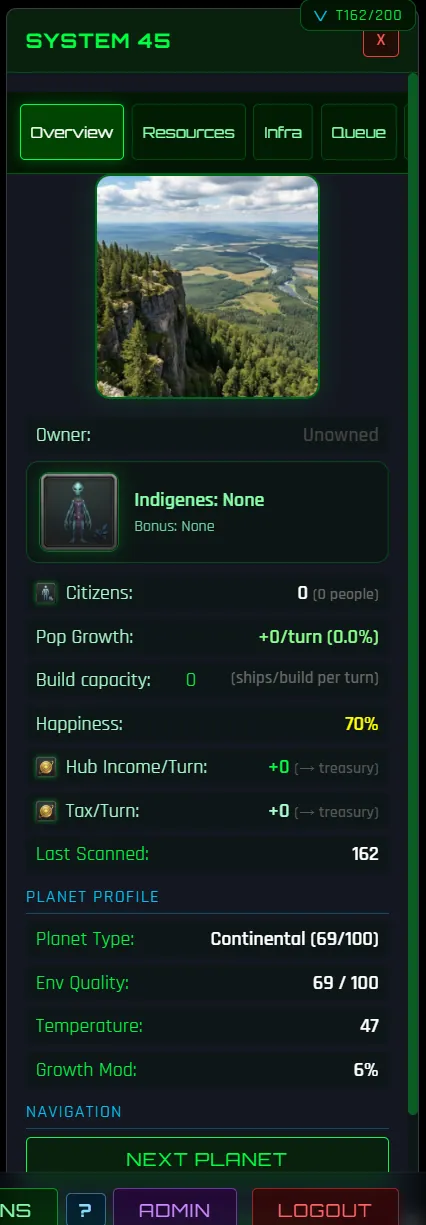
The planet overview: population, happiness, infrastructure and the maintenance line.
Under siege: while an enemy warship is in orbit, you cannot build or repair defense posts or starbases on that world. Your queued order waits and completes once the orbit is clear.
4.4 The Planetary Governor
Each planet has a Governor panel that builds for you. Turn on any mix of auto-mines, auto-logistics-hubs, auto-defense-posts, auto-data-labs and auto-build ships (needs a starbase).
Auto-build ships queues one hull per turn until your fleet reaches a cap. If you leave the cap unset it stops at 12 armed ships. Every automatic build is announced in your comms feed with the name of the governor that ordered it. Set your own cap for a bigger standing fleet, and pick the hull class with the ship preference list.
4.5 Terraforming
A Terraformer hull can move a world one step toward a better climate. Building one needs Hull 9 and Research Speed 5. Terraforming follows two chains, from Arctic and from Desert, through Continental or Ocean and on to Gaia. Barren worlds cannot be terraformed.
Each step takes 8 to 15 turns and costs Solars, Logistics and Data Cores. When it finishes, the world's maximum population rises, its temperature moves toward the ideal and its isotope density gets a small boost. It is slow and expensive, and it is how a crowded empire finds room without a war.
5. Happiness, Unrest & Rebellion
New commanders lose more worlds to this system than to enemy fleets.
Every colony has an unrest value from 0 to 100. Low happiness raises it, high unrest costs you output, and at 100 the world rebels.
5.1 How unrest builds up
Each turn, a planet's happiness sets the direction:
| Happiness | Unrest per turn |
|---|---|
| 80+ | -4 (recovering) |
| 60-79 | -2 |
| below 60 | +1 |
| below 40 | +3 |
| below 25 | +6 |
| below 15 | +10 |
On top of that, while unrest is rising: +2 if the planet's tax is above 14%, and +1 on a world whose natives are not your own kind. A world with a history of unrest builds it faster each time. Across the whole empire, a record of atrocities (Iron Fist and Cleanse, below) adds up to +5 unrest per turn on every planet you own, fading slowly.
5.2 The five stages
| Stage | Unrest | What it costs you |
|---|---|---|
| 0: Stable | 0-19 | Nothing |
| 1: Discontent | 20-39 | -5% mining and factory output |
| 2: Unrest | 40-59 | -15% output, -10% tax, -5% growth, and sabotage begins |
| 3: Riots | 60-99 | -35% output, -25% tax, no growth and no trade income |
| 4: Open Rebellion | 100 | The world rises (§5.4) |
At Stage 2 the population starts working against you: factory fires, mine collapses, stolen Data Cores, strikes that stop a planet's output for a turn, assassinated captains and sabotaged ships. Each arrives as an event card naming the planet.
At Stage 3 trade income from that world stops, unless you are the Merchant Conglomerate.
5.3 Keeping worlds quiet
- Lower the tax rate. Above 14%, every extra Solar costs you stability.
- Build Entertainment Complexes.
- Research governance (§14.2): Propaganda calms every world within 300 units of your capital; Internal Security gives +1 happiness on any world with a defense post and stops rebellion spreading; Political Science unlocks Reform.
- Watch the map. Your worlds at unrest 20+ show a colored ring: amber for Discontent, orange for Unrest, pulsing red for Riots and magenta for Rebellion. An alarm sounds the first time any world reaches Riots.
5.4 When a world rises
At 100 unrest the colony rebels. A three-screen cinematic plays, and a rebel faction named after the world (for example Rebels: Luna VIII) forms with a fleet of defectors flying your own hull designs, which sets course for your capital. The planet stays in your empire while you deal with them.
One turn later your council meets and asks for a decision. You have up to six options:
| Path | What it does | What it costs |
|---|---|---|
| Iron Fist | Mass arrests. Unrest to 0, the world is pacified for 30 turns and the rebel fleet disbands | 40-60% of the population · +2 atrocity · -15 opinion with every empire |
| Velvet Glove | Concessions and free buildings. Unrest to 30, +20 happiness | Solars, scaling with the world's history of unrest, and more each time you use it |
| Reform | Call a constitutional convention (needs Political Science) | The rebellion and its fleet continue while the convention sits, about 8 turns |
| Cleanse | Resettle the world with your own people | 2,000 Solars · +5 atrocity · -40 opinion with every empire |
| Independence | The world leaves your empire as a friendly Free State | You lose the planet · +25 opinion with every empire |
| Cultural Assimilation | (Cybernetic, Psionic and Bio-Engineered only) A 15-turn program, after which the world's people become your own kind | 800 Data Cores · the rebellion continues while it runs |
When a constitution is ratified, mismatched natives stop adding unrest anywhere in your empire, rebellions spread at half the rate and every world gets +10 happiness once.
Atrocities add up. Iron Fist and Cleanse settle one world and make every other world harder to govern for a long time. Independence costs you a planet and earns real goodwill. Reform fixes the whole empire, but you have to hold out against the rebels until it is ratified.
5.5 Spread
If a rebel state lasts 5 turns with its fleet intact, it starts stirring up its neighbors. Your worlds of the same people within 250 units that are already at 40+ unrest gain +5 unrest a turn, up to three worlds a turn. Internal Security stops this completely, and worlds within 200 units of your capital are never affected.
6. Ships, Hulls & Modules
6.1 Anatomy of a hull
Every hull has mass (its hull points and its upkeep), a fuel tank, a cargo hold, weapon mounts (beams, torpedoes, fighter bays) and a tech requirement. A bigger ship is not always better: mass costs upkeep every turn and makes a ship act later in combat (§10.1).
Ships are built at starbases, and each starbase's own tech caps limit what it can build (§15). The one exception is the Nomadic Mothership, which has its own shipyard.
6.2 The Shipyard
Select a planet with a starbase, open the Starbase tab, then Shipyard. You choose:
- a hull (only the ones your house and tech allow)
- an engine, a beam, a second beam on big hulls, and a torpedo type, from the tech you have researched
- modules, up to the hull's slot count
- then build, or SAVE DESIGN to keep it as a template
The price comes from your treasury (Solars) and from that planet's mineral stockpile.
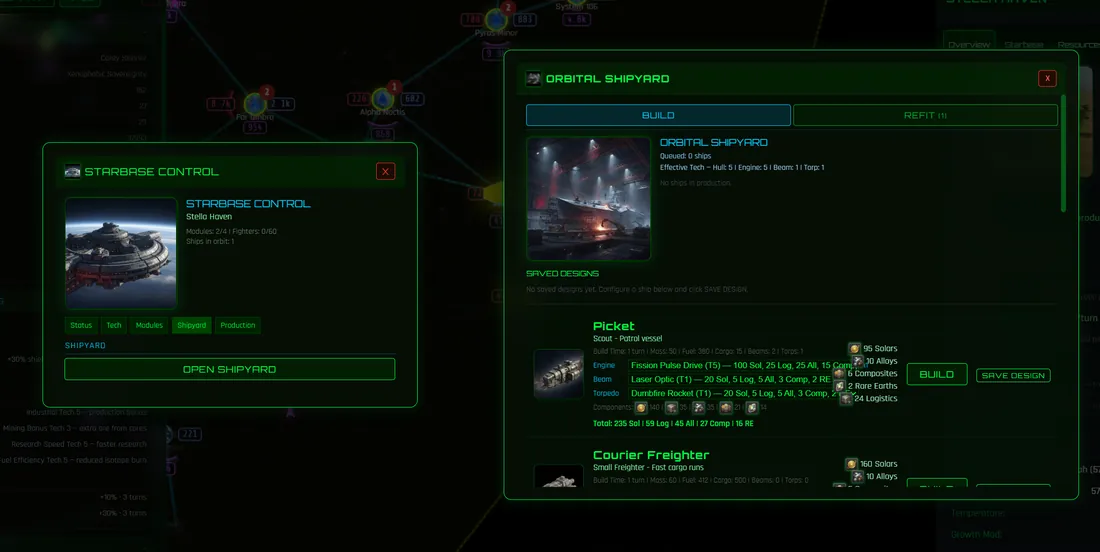
The shipyard: pick a hull, fit its weapons and modules, then build or save the design.
6.3 Modules
Module slots depend on hull mass: under 100: none · 100-249: 1 · 250+: 2.
| Module | Tech | Effect |
|---|---|---|
| Extended Fuel Tanks | 1 | +30% fuel capacity |
| Cargo Expansion | 1 | +40% cargo capacity |
| Reinforced Armor | 2 | +15% hull points |
| ECM Suite | 3 | -10% enemy hit chance against you |
| Point Defense Array | 4 | Intercepts incoming torpedoes |
| Targeting Computer | 5 | +10% weapon accuracy |
| Shield Capacitor | 6 | +20% shields |
| Cloaking Device | 7 | Invisible outside enemy sensor range |
Modules are fitted when the ship is built and show in its Overview tab. Saved designs keep them.
6.4 Hull abilities
Some hulls carry a built-in ability, listed in the hull's description in the shipyard: cloaking, shield auras that protect nearby friendly ships, psionic attacks, fortress plating, repair drones, fighter launches, advanced sensors and others. Hull abilities work in every battle, fleet against fleet as well as orbital fights.
Two hulls deserve a special mention:
| Hull | House | Tech | Ability |
|---|---|---|---|
| Veilrunner | Psionic Covenant | 3 | A phasing scout. It travels 30% farther each turn, burns 40% less fuel for the same distance and passes through enemy minefields untouched |
| Purge Lander | Xenophobic Sovereignty | 4 | An armored troop transport. Troops aboard count 1.5 × toward invasion strength and suffer half the usual losses when the invasion succeeds. The invade preview shows the bonus |
6.5 Refit
A ship docked at a friendly starbase can swap its engine, beams and torpedoes in the Refit panel for about 70% of the new parts' price, with a partial refund on what comes out. A refit that changes more than one part takes the ship out of action for a turn.
7. Captains & Officers
A ship fights better with a captain aboard.

Chief Engineer Zara Okafor, Technological Pioneers: a Navigator officer worth building a fleet around.
7.1 Recruiting
Any world you own with more than 500 citizens can produce captain candidates: a 5% chance each turn, and at least one every few turns. CAPTAINS → Recruit shows who is available: name, people, portrait, four skills (⚔ Combat · 🧭 Navigation · 🔬 Science · 👑 Leadership), trait leanings, a backstory and a price.
Skills decide which traits a captain tends to earn as they level up. You can hold 8 captains at once, so choose carefully.
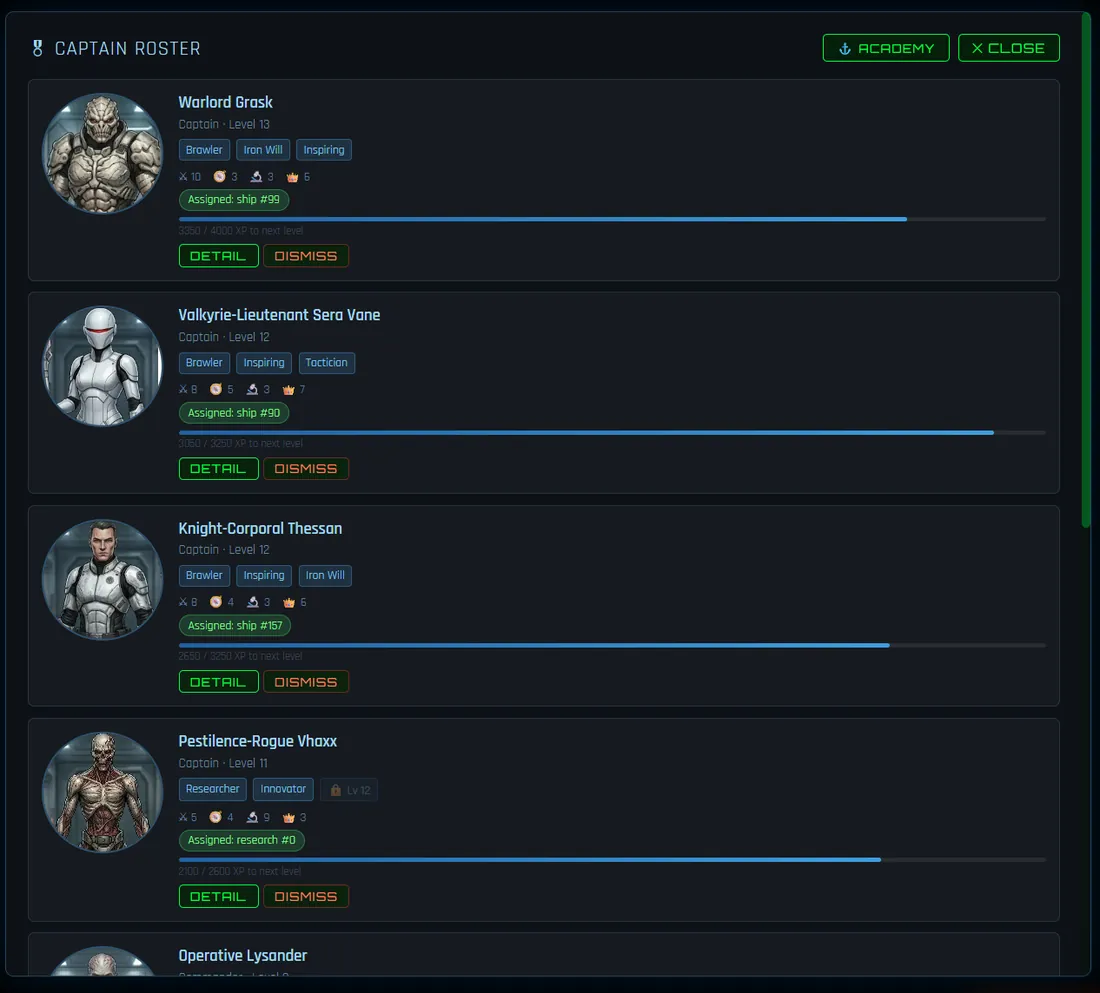
The captain roster: skills, traits and current posting for every officer you hold.
7.2 Postings
A captain takes one of three postings:
- Ship: their traits apply to that ship
- Planet (Governor): production, happiness and research on that world
- Research (Chief Scientist): empire-wide research, plus a second research slot (§14.3)
Each posting shows a CAPTAIN BONUSES readout listing exactly what that officer adds.
7.3 The traits
| Domain | Trait | Effect |
|---|---|---|
| Combat | Marksman | +15% beam accuracy |
| Torpedo Ace | +15% torpedo accuracy | |
| Iron Will | A ship in defensive posture holds until 10% hull instead of 25% before retreating | |
| Tactician | +1 decision card, +5% initiative | |
| Brawler | +20% damage at close range | |
| Commander | +12% initiative: the ship acts earlier every round | |
| Navigation | Navigator | +20% movement range |
| Fuel Efficient | -25% fuel burn | |
| Abyss Runner | Halves Abyss damage | |
| Wormhole Sense | +50% wormhole speed | |
| Pathfinder | Lets the ship's route include Abyss legs (they still take Abyss damage) | |
| Science | Researcher | +25% research speed |
| Archaeologist | +30% anomaly investigation speed | |
| Data Analyst | +15% Data Core output on that world | |
| Innovator | 10% chance to skip a tech level | |
| Leadership | Governor | +10% production on that world |
| Fleet Commander | Shares the captain's beam accuracy, torpedo accuracy and close-range damage bonuses with the whole fleet | |
| Inspiring | +10% combat effectiveness | |
| Recruiter | That planet finds candidates twice as fast |
Fleet Commander is the trait that turns one strong gunnery officer into a fleet-wide bonus.
7.4 Advancement
Captains earn experience by doing their job: fighting and winning battles, finding anomalies, finishing research and governing worlds. They reach up to level 15 and gain trait slots at levels 3, 7 and 12. Ranks run Ensign → Lieutenant → Commander → Captain → Admiral.
Each captain also has loyalty, which drifts from turn to turn with how they are treated. Loyalty matters most when things go wrong.
7.5 When a ship is lost
When a captain's ship is destroyed:
- about 15% of the time the captain is killed (higher for a captain on a vengeance mission or a Last Command), and a eulogy screen plays
- about 18% of the time the captain is captured, and you choose to ransom, rescue or disavow them. A captain with loyalty under 20 defects instead
- otherwise the captain is wounded for 5 turns, which costs 500 Solars, and cannot be posted until they recover
Put your best officers on ships you intend to protect.
7.6 Officer moments
Your captains also bring their own decision cards. At most 2 officer cards arrive in a turn; any more wait and arrive in later turns, oldest first.
- The Last Watch. A veteran (25+ turns of service, and level 3+ or two battles) asks for one last command: +10% damage, with twice the usual risk of death. At most one of these every 10 turns.
- The Empty Chair. When a captain with 15+ turns of service is killed in action, you can promote their first officer, who inherits half of the fallen captain's best skill, or leave the chair empty for a while (-5% damage for 5 turns, +10 loyalty for every captain).
- The Name on the Hull. When a known enemy captain kills one of yours, your senior captain can swear to settle the account (a 20-turn vengeance mission against that captain) or let it go for -5 loyalty.
- The Butcher's Tally. When one enemy captain's ship has destroyed a second of your ships, you decide: hunt that captain down, post a 3,000-Solar bounty that may get them retired by their own side, or endure the losses.
- The Council at the Reckoning. When the final countdown opens (§20.1), your two longest-serving captains argue for opposite strategies, and you choose whose advice to take.
Your captains also speak: a line from one of your officers appears on story events, eulogies, war declarations, first contacts and the turn summary.
8. Fleet Command
Giving every ship its own orders stops working at about twenty ships. Fleets fix that.
8.1 Fleets
FLEETS → New Fleet. Add ships, name the fleet and give it a number. A fleet has a flagship, a shared drive setting, a combat posture, a tactic and, if you like, a standing order.
A fleet move gives every member the same order at the same speed, so the fleet arrives together. Set the Drive Setting in the fleet's Movement row and it applies to every member, including moves already queued this turn.
8.2 Standing orders
Standing orders run at the start of Movement and only steer ships you have not given an order yourself. Your own orders always come first.
| Order | Behavior |
|---|---|
| Hold | Stay put |
| Guard | Move to a planet and stay within 8 units of it. With no target set, it guards your nearest planet |
| Patrol | Circle about 35 units out from the fleet's station, one full loop every 8 turns |
| Escort | Follow another of your fleets and stay within 5 units |
| ⚓ Muster | Send every member to one rally planet. Ships that arrive wait there, and the order clears itself when the last one lands, with a comms message that the fleet has assembled |
Choose Guard, Muster or Escort and a picker opens under the Movement row listing your planets or your other fleets. Tapping the planet on the map works too. Your comms feed reports what every automated fleet did each turn.
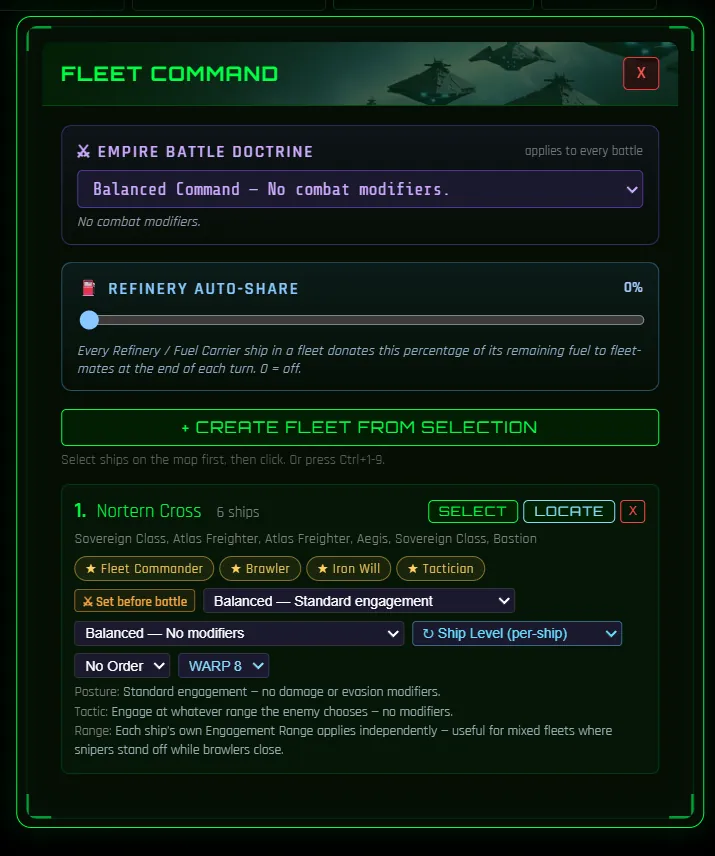
Fleet Command: grouping, drive setting, posture, tactic and standing orders.
8.3 Posture, tactic and engagement range
Posture:
| Posture | Effect in battle |
|---|---|
| Balanced | No modifiers |
| Aggressive | +5% accuracy, +10% damage |
| Defensive | -10% damage, +5% evasion. The only posture that retreats from a battle when badly damaged |
| Screen | The same modifiers as Defensive |
Tactic:
| Tactic | Effect in battle |
|---|---|
| Balanced | No modifiers |
| Sniper | +15% damage at long range |
| Brawler | +15% damage at close range |
| Afterburners | +5% accuracy and +5% damage at close range, +5% evasion |
| Turtle | -5% accuracy, -10% damage, +2% evasion |
Engagement range is set per ship in its Orders tab: long, flexible or close. It decides how the ship moves through the range bands. A formation row (below) overrides it.
Combat mode is also per ship: DEFEND fights normally; RETREAT sends the ship to a neighboring world along a lane instead of fighting.
Match these to your weapons. A Pioneer fleet of long-range beams suits Defensive and Sniper; a Bio-Engineered swarm suits Aggressive and Brawler.
Formation rows
Assign a ship to a formation row in the Fleet window and it fights at that row's range regardless of the rest of the fleet:
| Row | Fights at | Best for |
|---|---|---|
| Vanguard | Moves in to close range and stays there, with +10% damage once it arrives | Close-range beams (about tech 1-3) |
| Core | Long, then medium, then close, with the fleet | Medium-range beams (tech 4-6) |
| Long Range | Stays one band behind and never closes to close range | Long-range beams (tech 7-10) and torpedoes |
⚡ AUTO-ASSIGN ROWS places every unassigned ship according to its weapons. Ships you have placed yourself stay where they are.
Battle Plans
A Battle Plan sets posture, tactic and range together in one click and adds a small modifier of its own:
| Plan | Effect |
|---|---|
| Torpedo Alpha Strike | Torpedoes hit harder at long and medium range; beams slightly weaker |
| Screen and Envelop | +5% evasion, flexible range, slightly less fire |
| Brawler's Rush | +10% damage at close range, -10% at long |
| Standoff Doctrine | -8% damage taken at long range, slightly less output |
A plan's damage modifier never goes beyond ±25%.
9. Travel: The Axis and the Abyss
There are two ways to cross the galaxy, plus wormholes for the shortcuts in between.
9.1 Axis lanes
The Axis lanes are the Progenitors' surviving corridors, drawn as blue lines on the map. Lane travel is faster and cheaper: ships move at full speed and burn about half the fuel they would in open space. Ships route along the lanes automatically, and the route preview shows each hop.
The lanes form a network. A world with no lane connection can only be reached across the Abyss.
A ship that arrives at an enemy world (with no Non-Aggression Pact) stops there. Its route is cleared and a battle follows.
9.2 The Abyss
Shift+click a destination to force an Abyss jump: a straight line through open space, ignoring the lanes. On a phone, with a ship selected, press and hold on a planet for about a second and a half. An Abyss jump is slower per unit of distance, burns more than twice the fuel and damages the ship every turn: 8% of its current hull, or 5.5% with better armor tech.
Any ship that is not on a lane and not at a planet takes this damage, whatever its orders. A ship left stranded between planets keeps taking damage until you move it.
The Nomadic Wanderers take half damage, and an Abyss Runner captain halves it again.
Crossing the Abyss also reveals hidden systems within 60 units of the ship's path (120 with an Abyss sensor). Use it to reach isolated worlds and to arrive where nobody is watching.
9.3 Drive settings and fuel
The Drive Setting (warp) sets a ship's speed, and fuel use rises with it.
- Overdrive is running above your engine tech. One or two tiers over costs nothing extra; three tiers over costs +50% fuel, four +100% and five or more +200%.
- Underclocking below your engine tech saves fuel: 5% at one tier under, up to 30% at six.
The ship panel shows the total fuel cost and arrival time before you commit.
Running dry: a ship on a lane without enough fuel crawls forward at a quarter of its usual speed. A ship trying an Abyss jump or a wormhole transit without enough fuel cannot make it. A ship outside your supply range moves at 70% speed.
9.4 Wormholes
Some worlds are linked in pairs by wormholes, and some late-game projects create more. A wormhole transit is about 13 times faster than lane travel (half as fast again with a Wormhole Sense captain) and costs very little fuel (at least 15 isotopes).
Wormhole transit is your choice. When a route passes through one, the game asks: USE WORMHOLE or ORBIT PLANET. Two details:
- A ship that has agreed to a transit keeps that choice when you reissue orders along the same route, including when you change its drive setting.
- If a ship is sitting at a wormhole mouth and you order it to that wormhole's far end, it takes the wormhole automatically.
9.5 Minefields
Ships with torpedo mounts can lay minefields along a lane; ships with beams can sweep them. Mines damage anything that crosses, decay slowly and are used up as they hit. A Veilrunner passes through untouched. Mines are a cheap way to make a chokepoint expensive.
9.6 Supply routes
Give a freighter a supply route between two of your worlds and it loads a set cargo, flies, unloads and repeats with no further orders. It refuels at each end. If you ask for more cargo than the hold can carry, the load is shared out across the resources.
If a route cannot refuel or finds nothing to load, it pauses and tells you. Refinery-class hulls can also share their fuel with the rest of their fleet each turn; set the share in Fleet Command.
10. Combat: The Initiative Doctrine
Combat starts automatically when hostile ships come within range of each other, and it runs through three range bands in order: long → medium → close.
10.1 Who shoots first
Defenders shoot first. Before the battle, every defending starbase and defense post fires an opening salvo at full strength, and the attackers cannot fire back. Structures keep firing in every round after that, last in the turn order.
Ships then act in initiative order, worked out again whenever a ship is destroyed. Initiative depends on:
- Engine technology, the biggest factor
- Low mass: small ships act before capital ships
- Hull condition: damaged ships act later
- Kills: ships with confirmed kills act sooner, up to a cap
- Age: ships in long service act sooner
- Captain traits: Commander (+12%), Tactician (+5%)
- A random roll
Each ship picks one target per round and fires every weapon at it.
10.2 Weapons
| Weapon | Best band | Character |
|---|---|---|
| Beams | Depends on the tier (below) | Your main guns. 10 tiers |
| Torpedoes | Long | Heavy damage at range, weak up close, limited ammunition. 8 tiers |
| Fighters | Close | Launched from bays; most accurate at close range (+15%) and good at medium (+10%); thinned out by point defense |
Beams change as they improve. Each tier has an ideal band, and the family moves outward as the technology advances:
| Beam tier | Weapon | Ideal band |
|---|---|---|
| 1-3 | Laser Optic · UV Pulse · Plasma Thrower | Close |
| 4-6 | Ion Stream · Positron Beam · Phase Disruptor | Medium |
| 7-10 | Graviton Lance · Meson Projector · Zero-Point Emitter · Gamma Ray Burst | Long |
A beam does about 10% more damage in its ideal band. Tiers 1-3 and 7-10 also do about 10% less in their worst band; tiers 4-6 have no weak band. A fleet of tier-2 beams and a fleet of tier-8 beams want opposite tactics, so when you upgrade your beams, check your ships' engagement range and formation rows (§8.3) as well.
Torpedoes run out. Count your salvos before a long siege, and resupply at a starbase.
A mixed fleet fights well in every band.
10.3 What else counts
Modules (ECM, point defense, targeting computer, shields, armor), hull abilities (§6.4), captain traits, posture and tactic, battle plans, house bonuses and territorial influence (§19) all feed into the same calculation.
10.4 Reading the battle
Every battle produces a battle report (SUBSPACE COMMS → Combat Logs): damage round by round, a breakdown by weapon, and who destroyed what.
The VCR replays the battle: ships moving between bands, tracers, torpedo runs, fighter sorties, shields failing, and a final scoreboard with an MVP.
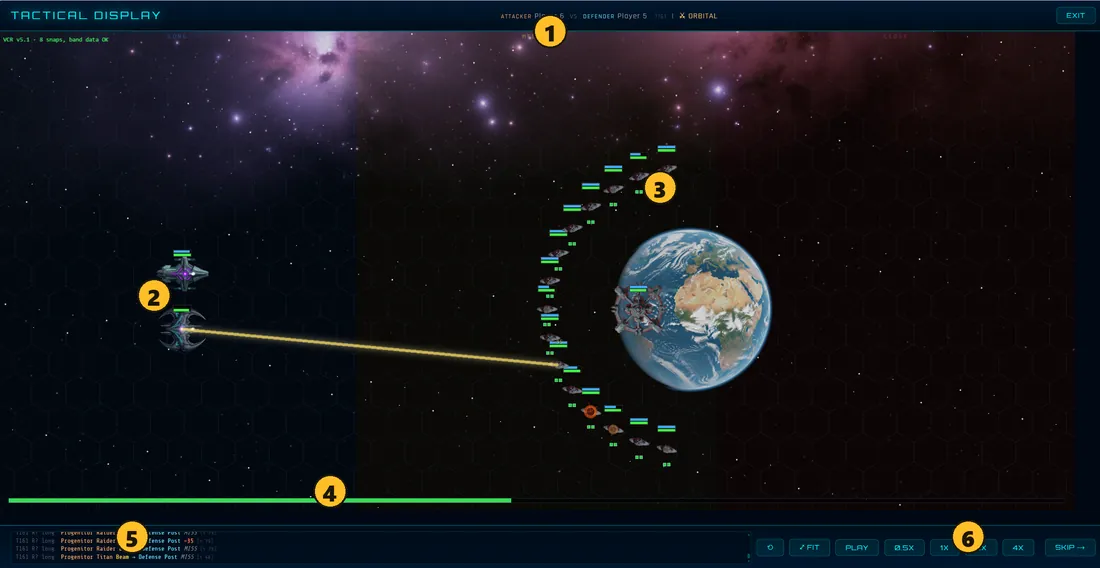
The replay display.
| What it shows | |
|---|---|
| 1 | Header: attacker and defender, their houses, the turn, and an ⚔ ORBITAL badge when a world is involved |
| 2 | Your line. Ships close in or hold back according to their engagement range; tracers show every shot |
| 3 | The enemy line. The green bars above each hull are shields and structure |
| 4 | Timeline. Scrub through the battle; the band label shows whether you are watching long, medium or close range |
| 5 | Play-by-play. Every shot in text: weapon, tier, target and damage, plus misses and point-defense intercepts |
| 6 | Controls: play, pause, speed, restart, and ⤢ FIT to show the whole battle |
On a phone, pinch, drag and double-tap work; on a desktop, the f key resets the view.
If you lost a battle and do not know why, watch the replay. The usual answer is beams of the wrong tier for the range the fleet chose to fight at.
REPLAY restarts the battle from the opening formation. The 🔗 SHARE REPLAY LINK button gives you a link that opens the replay directly.
Replays are kept for the most recent 10 turns and battle reports for 40. After 10 turns a report still shows the result and the damage breakdown, without the replay.
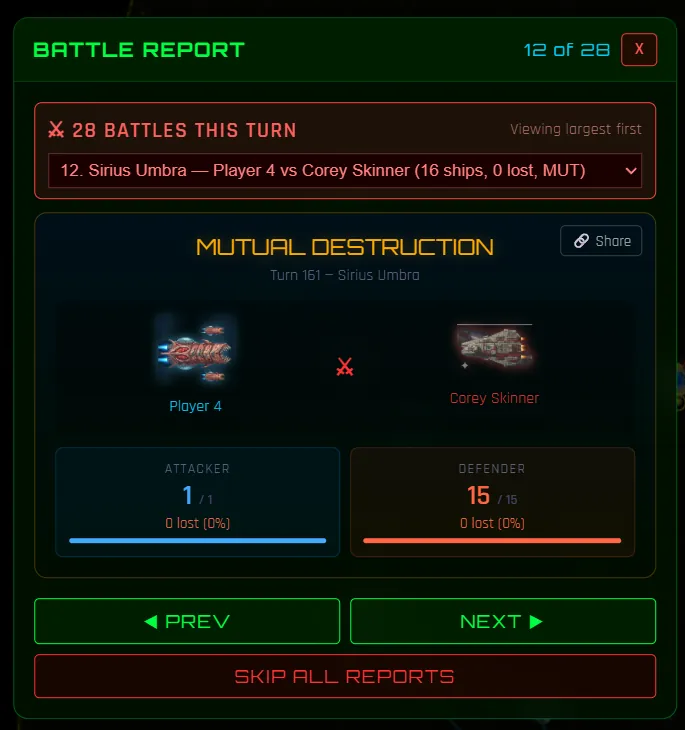
The battle report: losses, damage by weapon, and the button to watch the replay.
11. Diplomacy
Open DIPLOMACY from the top bar to see every empire you have met, their house, their standing with you and what you can offer them.
11.1 First contact
You can only deal with an empire you have met. Until one of your ships or worlds has come within sensor range of theirs, the panel shows NO CONTACT, and proposals, gifts and declarations of war are refused.
11.2 Opinion and reputation
Every pair of empires has an opinion score from -100 to +100 that drifts slowly back toward neutral. It moves when you act:
| Action | Effect |
|---|---|
| Making an offer | Small positive |
| Having an offer accepted | Positive, both ways |
| Having an offer rejected | Small negative |
| Bombarding their world | Large negative |
| Atrocities (Iron Fist, Cleanse) | Negative with every empire |
| Granting independence to a rebel world | Positive with every empire |
| Gifting Solars | Positive, more for a bigger gift |
| A spy mission of yours caught or failed (§17) | Negative |
Your galaxy-wide reputation sits on a seven-step scale from Paragon to Anathema. It raises or lowers your trade income (from ×1.15 down to ×0.85) and decides which treaties AI empires will consider.
11.3 Agreements
| Agreement | Meaning | Lasts |
|---|---|---|
| Non-Aggression Pact | Neither side's ships will fight the other, and neither can invade the other's worlds. The easiest deal to make | 25 turns |
| Trade Agreement | Income for both sides | 30 turns |
| Research Pact | Shared research benefit; needs good relations | 25 turns |
| Defense Alliance | Mutual military support; the hardest to get, and the Nomadic Golden Age trigger | 40 turns |
Agreements run out on their own. The only way to end one early is to declare war.
11.4 Humans and AIs
Propose a deal from the empire's row. An AI answers at once, based on its personality, its strategy and its opinion of you. Another commander receives the offer in their Diplomacy panel and answers when they next play.
When a commander sends you an offer, it arrives as a full viewscreen: their house's envoy on screen, voiced, with Accept / Deny / Ignore. Declarations of war arrive the same way.
11.5 War and peace
Declaring war cancels your agreements with that empire, drops their opinion of you to the floor and allows combat. Offering peace later returns both sides to a cautious truce, not to friendship.
11.6 Gifts
Gift Solars from any empire's row to win goodwill, buy a neighbor's patience while you fight elsewhere, or keep a stronger empire busy with someone else.
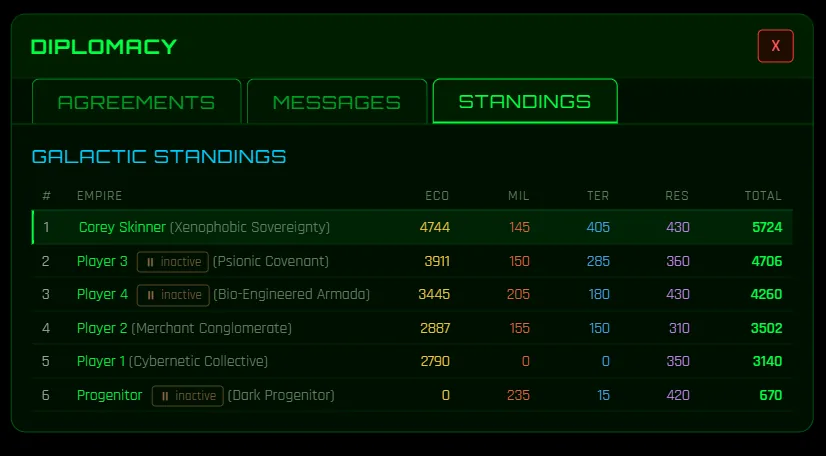
Diplomacy standings: who is at war with whom, and where you stand with each of them.
12. Exploration, Anomalies & Archaeology
12.1 Sensors and fog
Your ships and worlds have sensor range. Enemy ships are only visible inside it, but a planet you have scanned stays on your map. The Psionic Covenant see 50% farther than anyone else, and the Technological Pioneers 25% farther.
Scouts are cheap, so keep several out for the whole game, not just the opening.
12.2 Anomalies
Anomalies are scattered across the Shattered Axis: Progenitor ruins, derelict ships, biological oddities and machines still running. They are marked in violet on the map and listed in the ANOMALIES panel, whose badge shows how many are waiting for you.
An investigation takes several turns and a few Data Cores each turn:
- Discovery: a cinematic when your ship arrives
- Investigation: several turns, costing Data Cores each turn
- The findings: the result is decided but kept sealed until you click "Reveal the findings"
If you cannot pay the ongoing cost, the investigation pauses and waits for you instead of failing. Keep an eye on the badge so a paid-for dig is not forgotten.
12.3 Archaeology chains
Three long stories can appear in any game, each about five stages deep:
- The Shattered Archive: a Progenitor data vault. Crack it for Solars, Data Cores and a hull breakthrough.
- The Dormant Gate: a cold Progenitor transit gate. Bring it back to life, then study its records for Solars, Data Cores and an engine breakthrough, or strip it for alloys and composites.
- The Echo Signal: a repeating transmission in an unknown language. Decoding it pays well; decoding it carelessly tells the galaxy where you live.
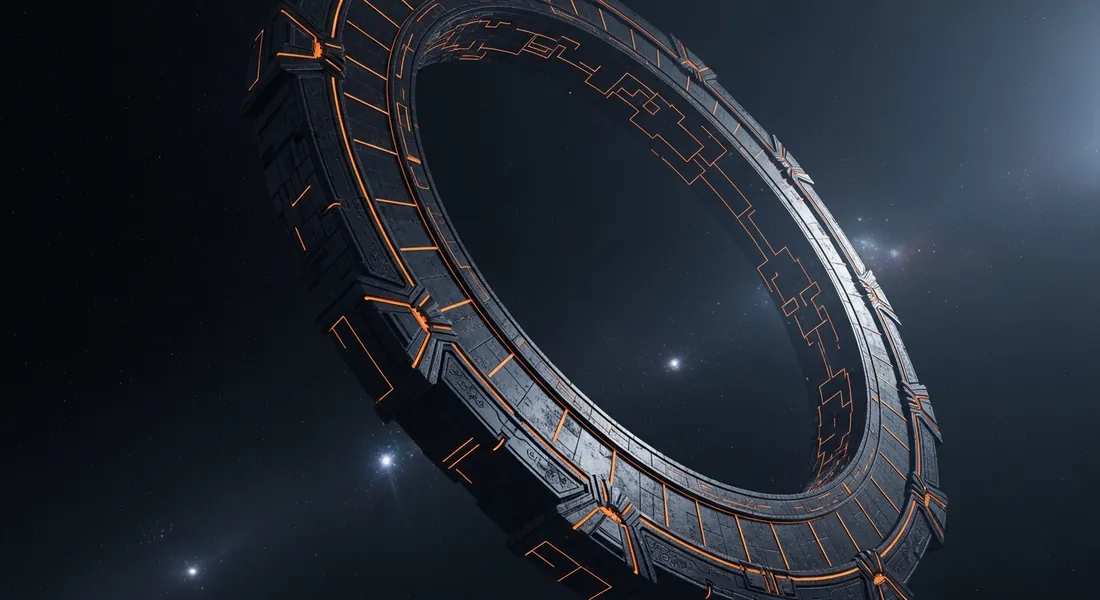
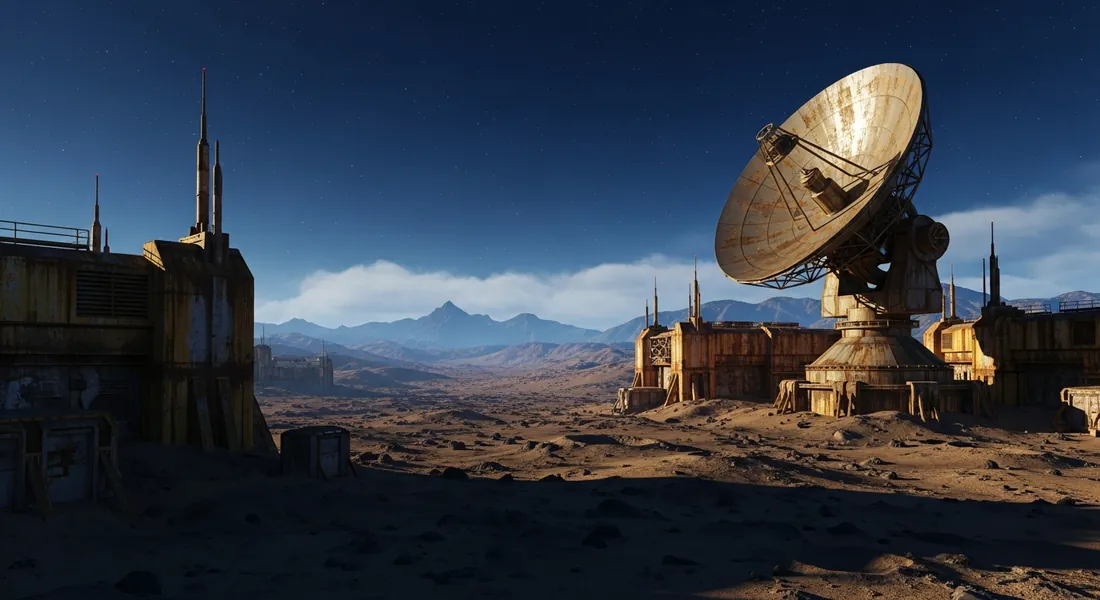
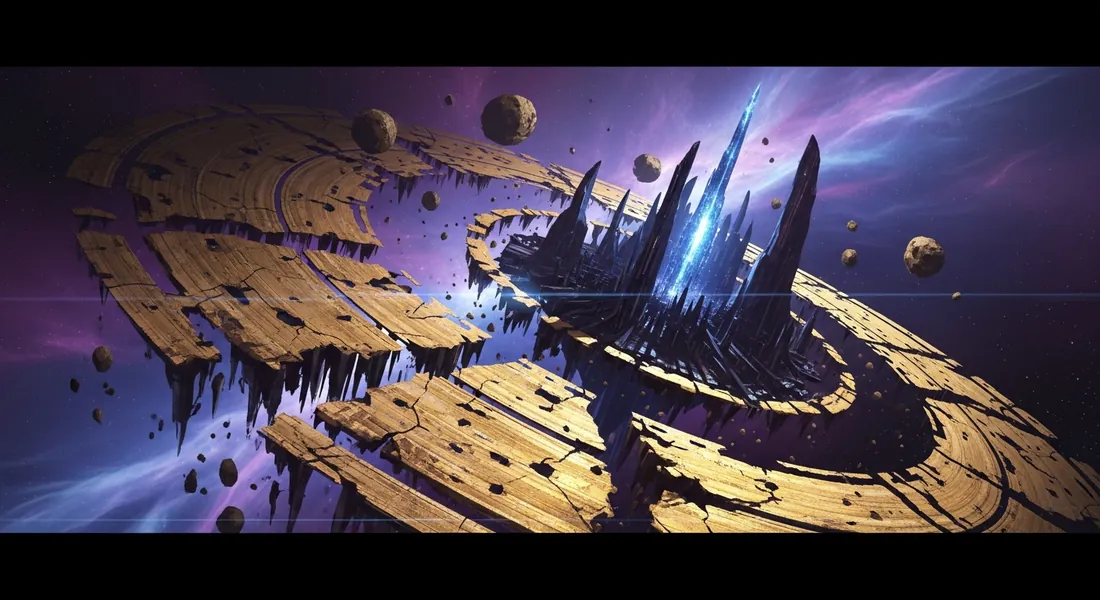
The three chains, at their first stage.
Each stage is a full cinematic with real choices, and the rewards are large.
Anomaly events fire once per world for each commander, so a rival can find their own version of the same ruin.
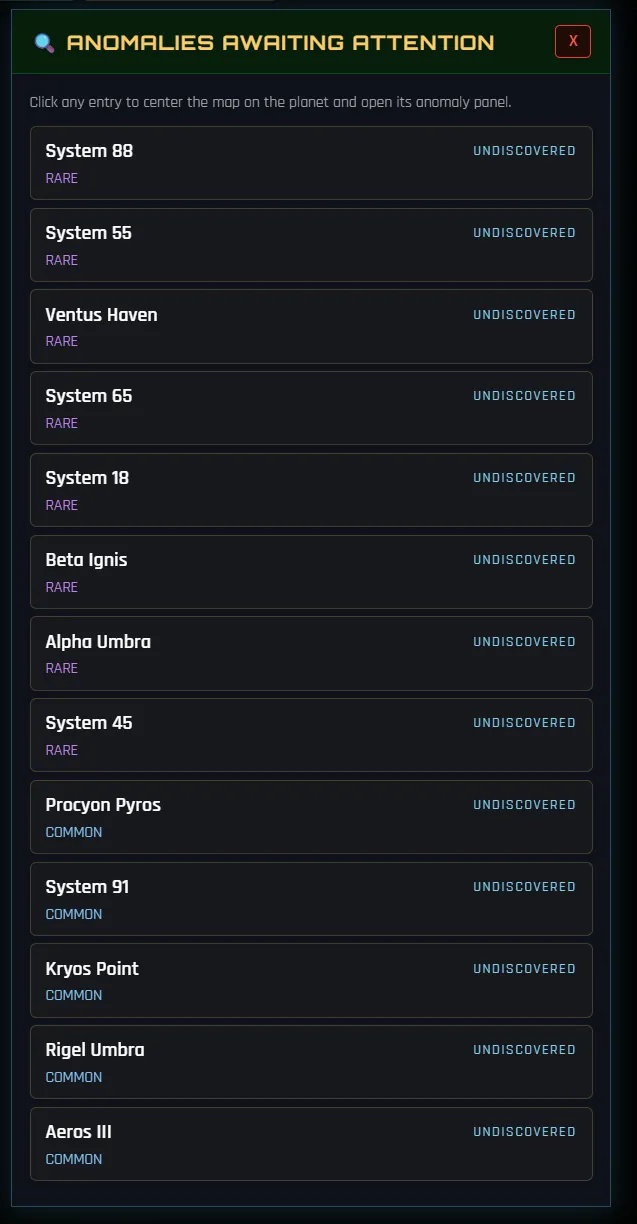
The anomalies panel lists every discovery waiting on your decision.
13. The Neighbors
The other empires are not the only ones out here.
13.1 Native peoples
Many worlds have native populations: Silicon Minds, Tech Cultists, Fungal Networks, Warrior Tribes, Trading Clans, Agrarian Collectives, Deep Burrowers and Precursor Remnants. Most bring a bonus when you colonize. Four of them guard their worlds:
| Guardian | Their world | What they want |
|---|---|---|
| Silicon Minds | The Silent Archive | Keep a ship in orbit for 6 turns while they judge you, or pay them off for an engine breakthrough |
| Tech Cultists | The Ember Conclave | The same 6-turn vigil, or pay them off for a beam breakthrough |
| Fungal Network | The Mycelial Maw | Study it for 6 turns. They cannot be bought. Study it or fight it |
| Warrior Tribes | The Ashwake Raiders | Tribute: 150 Solars a turn for 5 turns. Miss a payment and the count pauses |






The peoples who were here first. Four of them guard their worlds.
These encounters are the early game's first big decisions: wait them out or fight, close to home, in the first twenty turns or so.
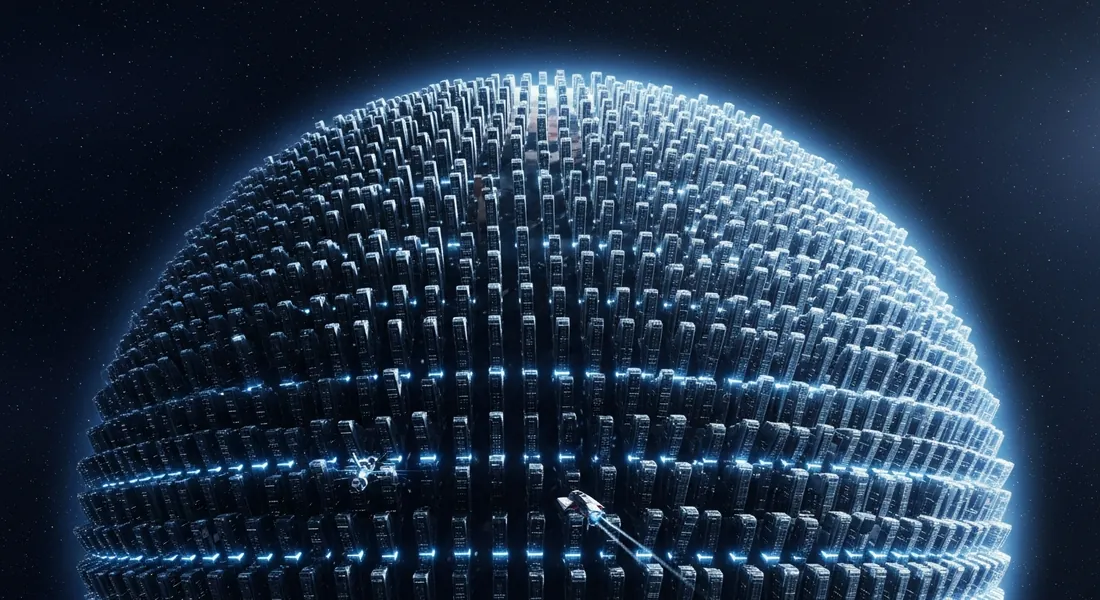
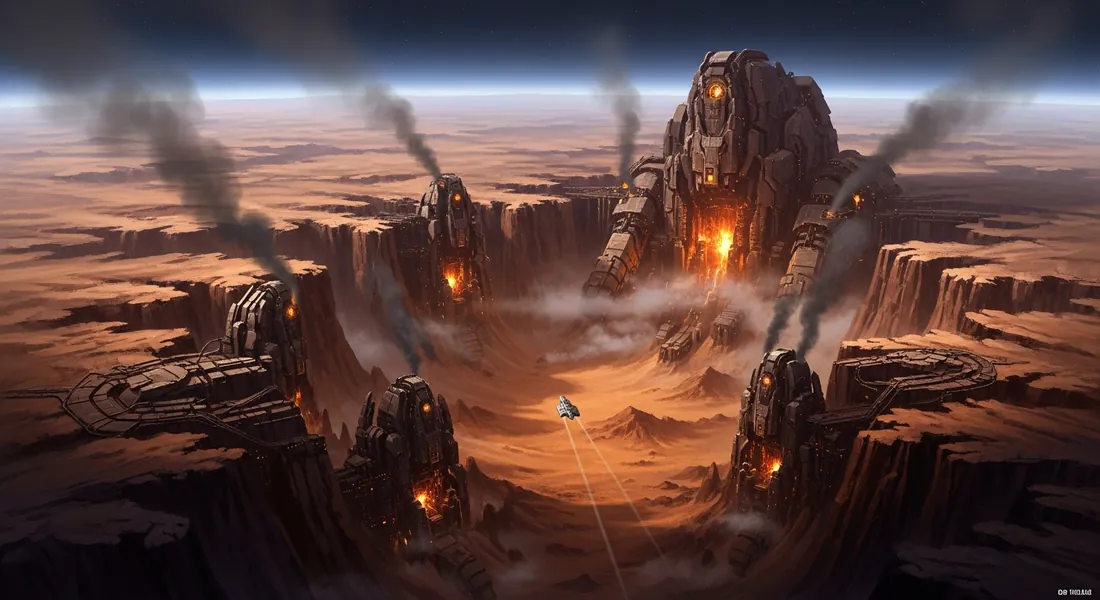

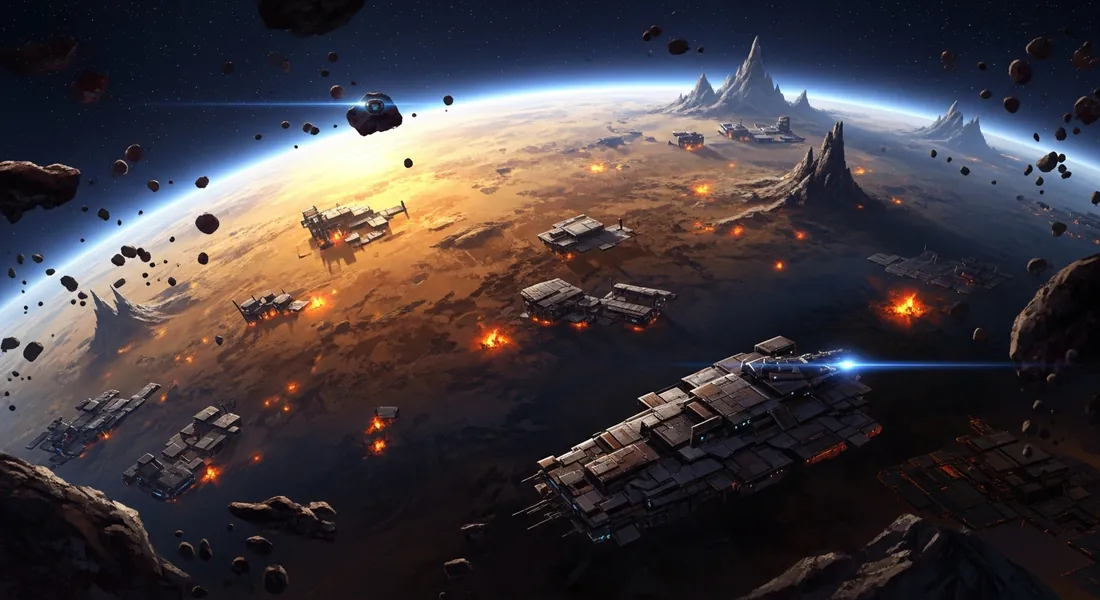
The four guardian worlds.
13.2 Minor powers
Three small empires start well away from the home systems and play by the same rules you do. Their names change from game to game:
- The fortress power (for example the Ashen Concord): few worlds, heavily defended, and the only minor power with a starbase.
- The war band (for example the Grave Marches): a strike squadron strong enough to beat a small fleet and too weak for a real one.
- The schemers (for example the Silent Choir): they work through espionage rather than fleets.
A minor power stops expanding at 6 worlds, though it keeps raiding and bombarding. You can fight them, outgrow them or leave them alone. They cannot win the game, but they can take a world from you.
13.3 Pirates
Pirate raiders hit the frontier throughout the game, more often in the middle stages. They go after lightly defended worlds and lone freighters. A fleet on Patrol or Guard is the cheap answer.
13.4 The deep dark
From about turn 12, a ship that wanders more than 150 units from any planet risks meeting the Abyss Leviathan, which ambushes ships in deep space. It strikes each commander at most once per game and does not chase.
Keep lone ships near charted space, or take the risk knowingly.
14. Technology & Research
Data Cores are your research currency. Data Core Facilities produce them into an empire-wide pool.
14.1 The disciplines
| Line | Ceiling | What it buys |
|---|---|---|
| Hull | 10 | Bigger ships; the top hulls need Hull 9+ |
| Beam | 10 | Your main guns; the ideal range band moves from close to long as the tier rises (§10.2) |
| Engine | 9 | Speed, range and combat initiative |
| Torpedo | 8 | Long-range firepower |
| Armor | 6 | Passive protection |
| Shield | 6 | Active protection |
| Point Defense | 6 | Torpedo and fighter interception |
| Industrial · Mining · Defense HP · Research Speed · Fuel Efficiency | 5 each | Economy and logistics multipliers |
| Scan | 4 | Sensor range |
| Orbital Defense | 3 | Raises the defense-post cap |
Costs climb steeply: about 120 × (current level + 1)² Data Cores. The first upgrade costs a few hundred; taking a line to its ceiling costs thousands. You cannot max everything, so plan a path.
Engine tech is often undervalued. It sets your speed, your fuel economy and your initiative in every battle.
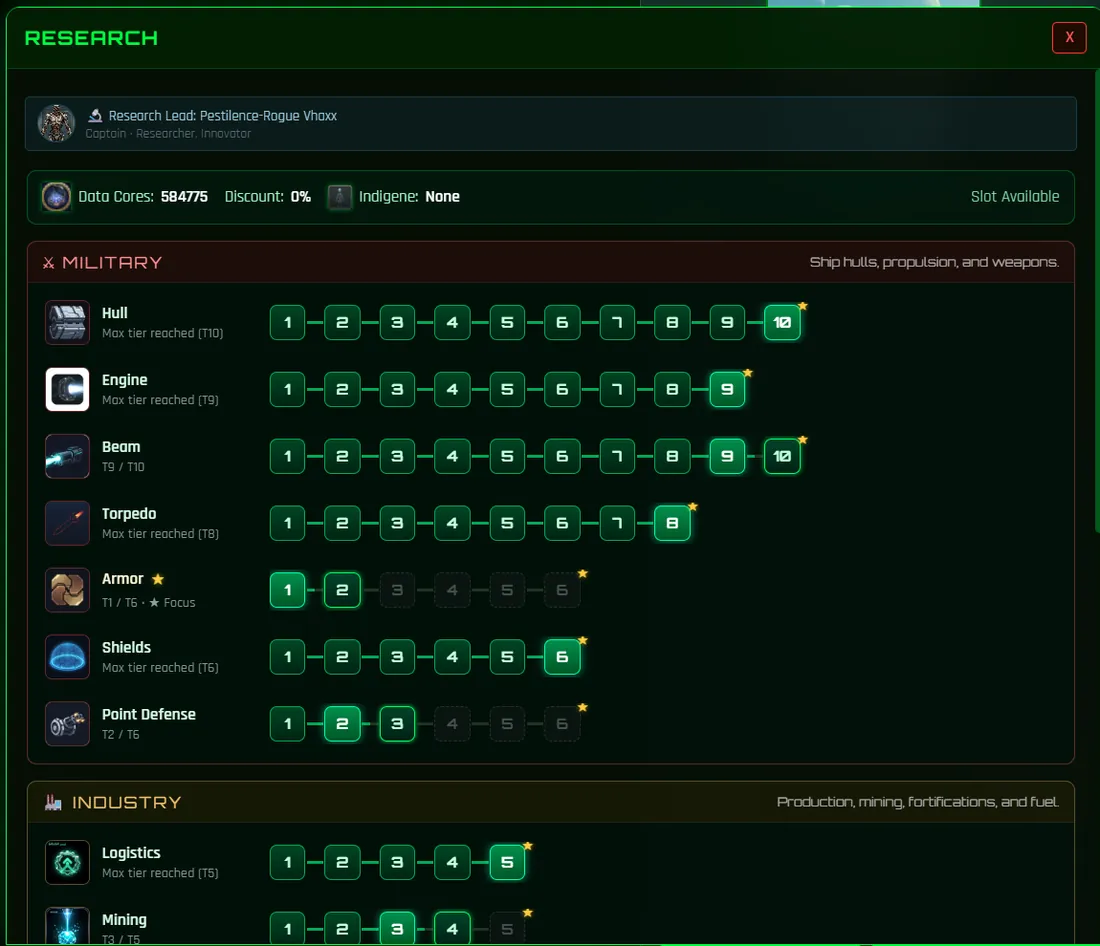
The research tree: each discipline, its current level and the price of the next tier.
14.2 Governance techs
Three techs exist to hold your empire together (§5):
| Tech | Cost | Effect |
|---|---|---|
| Political Science | 1,000 DC | Unlocks the Reform rebellion path; -25% Entertainment Complex price |
| Propaganda | 1,500 DC | -2 unrest per turn on every world within 300 units of your capital |
| Internal Security | 2,500 DC | +1 happiness on any world with a defense post; stops rebellion spreading |
Three more belong to one house each: Genetic Pacification (Bio-Engineered: Cleanse leaves no atrocity stain), Neural Conditioning (Cybernetic: Cultural Assimilation takes 8 turns instead of 15) and Psionic Calm (Psionic: ×0.7 unrest build-up on every world).
14.3 Parallel research
You research one thing at a time until you post a captain to Research, which opens a second slot. An outstanding science officer (science 9+, level 6+) opens a third.
The slots share your Data Core income instead of multiplying it: with two programs running, each one advances every other turn. Parallel research gives you flexibility rather than speed, so you can push a weapon line and an economic line together.
14.4 Late unlocks
Advanced empires unlock megastructure engineering: huge, expensive projects that can change the course of a game. This manual does not name them. Keep pushing your tech and you will find them.
15. Starbases
A starbase is a shipyard, a fortress, a supply hub and a tech ceiling. One per world.
Every starbase has:
- Its own tech caps for Hull, Engine, Beam and Torpedo, separate from your empire tech and never higher than it. Raising a cap costs about a quarter of the matching research price, paid in Solars and in Logistics from that planet. A starbase cannot build a ship beyond its own caps, which is the usual reason a new commander cannot build the hull they just researched.
- A shipyard
- Module slots: 4 at the standard tier
- Fighter bays, each holding 30 fighters that defend the system
- A defense rating: the starbase fights as a unit in orbital combat and fires in the defenders' opening salvo (§10.1)
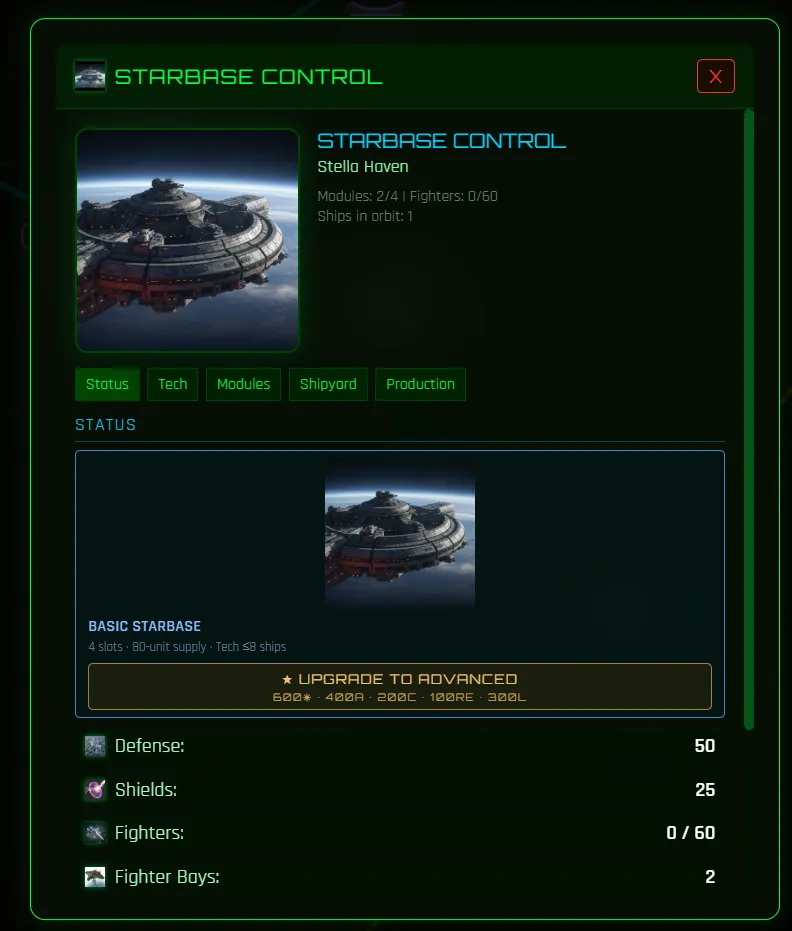
Starbase management: tech caps, modules, production and defenses.
15.1 Modules
| Module | Effect |
|---|---|
| Defense Grid | Heavier orbital weapons |
| Shield Matrix | Station shields |
| Fighter Bay | More interceptors |
| Repair Dock | Repairs ships in orbit |
| Sensor Array | Wider sensor coverage |
| Galactic Marketplace | Opens the commodity market (§16.2) |
15.2 The Advanced tier
Upgrading a starbase to Advanced raises its module slots from 4 to 6 and nearly doubles its supply radius. It costs hundreds of every mineral plus Solars, and it turns a forward base into a real staging point.
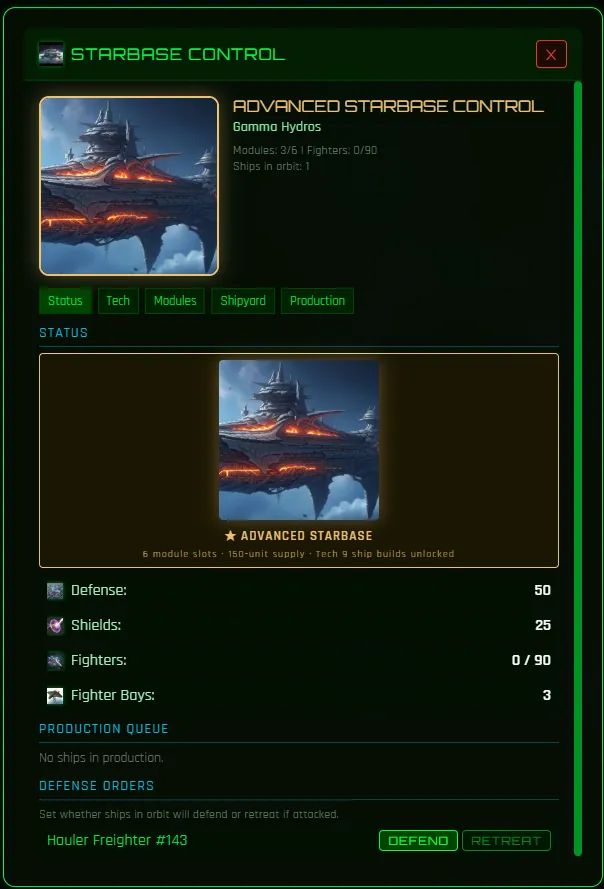
An Advanced starbase: six module slots, a 150-unit supply radius and Tech-9 hulls unlocked.
15.3 World Destroyers
Finish an Orbital Ring megastructure and your house unlocks its own World Destroyer. It takes ten turns to build. Each house has one, under its own name, and all eight share the same stats so that no house has an advantage:
Omega Assimilator · World-Eater Leviathan · Purifier Dreadnought · Mind-Shatter Apex · Executioner Titan · Final Horizon · Dominion Forge · Singularity Engine
Its weapon is the Planet Cracker. Put the ship in orbit of a target world and prime the weapon. Everyone who can see the ship watches the countdown: 5 turns from priming to detonation. The victim receives a Final Transmission naming the world, then the strike destroys every building, starbase, defense post and citizen on it. It is the worst thing you can do to another empire, and it leaves a permanent atrocity stain on yours (§5).
AI empires build and use World Destroyers too, at most two each and never without an escort.
16. Trade, Markets & Logistics
16.1 Trade routes
Set up a trade route between two of your own worlds from the TRADE panel. Each route pays Solars every turn:
50 + (combined citizens of both worlds ÷ 500) + (distance × 0.1)
- You can run up to 5 routes. Opening one costs 1,000 Solars, and a route runs for 15 turns.
- An armed enemy ship within 50 units of a route blockades it. Pirates occasionally halve a route's income for a turn.
- A world in Riots stops paying (§5.2), unless you are the Merchant Conglomerate.
- The Merchant Conglomerate earns 25% more from every route plus 15 Solars per paying route, which makes a wide Merchant trade network the best income in the game.
Trade Agreements with other empires (§11.3) are a separate source of income.
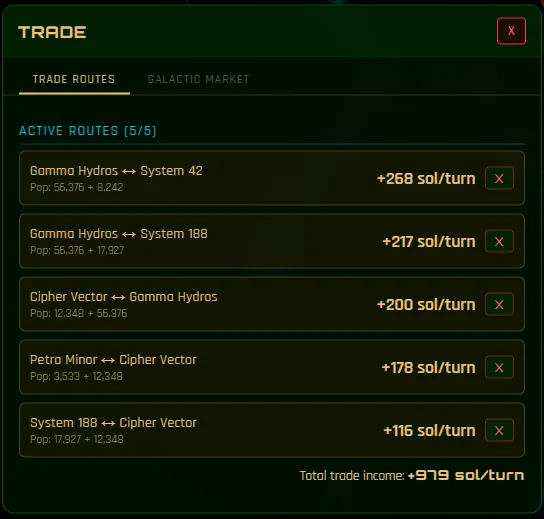
Five active routes paying nearly a thousand Solars a turn: a mature trade network.
16.2 The Galactic Market
With a Galactic Marketplace module on a starbase, you can trade on the commodity exchange: buy and sell minerals and Logistics at prices that move with galaxy-wide supply.
- Purchases arrive 3 to 7 turns later. The Trade panel lists everything in transit.
- You can buy at most 150 + 15 × (your planet count) of each resource per turn.
- Cargo is lost if the destination world changes hands before it arrives.
- The Merchant Conglomerate pays 15% less.
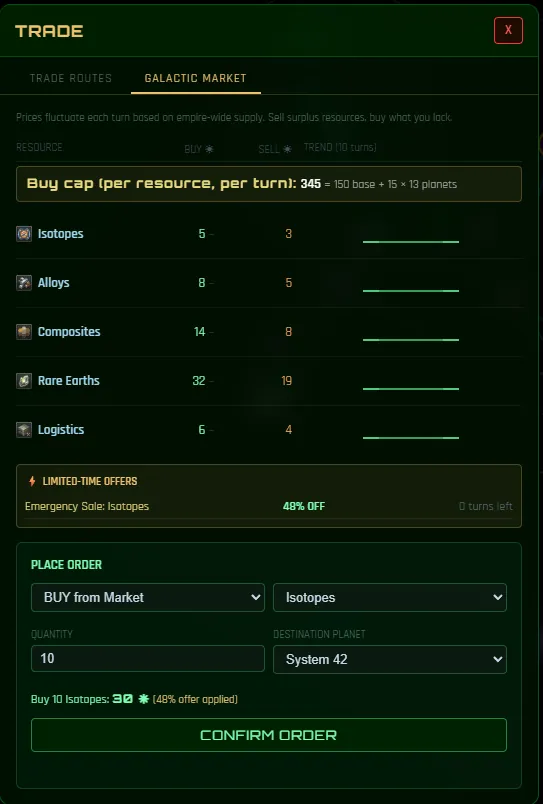
The commodity exchange. The per-turn buy cap is in the header, alongside limited-time offers that undercut it.
16.3 Supply routes
See §9.6.
17. Espionage
Open ESPIONAGE for four missions:
| Mission | Base odds | Price | Cooldown | What it does |
|---|---|---|---|---|
| Scan Fleet | 70% | 500 Solars | 3 turns | Shows a rival's fleet positions |
| Sabotage Production | 50% | 1,500 Solars | 8 turns | -50% factory output across the target's whole empire for 3 turns |
| Plant Agent | 45% | 3,000 Solars + 5 Rare Earths | 15 turns | A 10-turn intelligence feed from inside their empire |
| Steal Technology | 35% | 2,000 Solars + 10 Rare Earths | 10 turns | Takes one tech level |
The Psionic Covenant run every mission 20% better. No mission's odds go above 95%. Targets defend with sensor coverage and defense posts.
Getting caught costs you. When a mission is detected, the target is told who sent it and your reputation drops. A failed mission also damages relations with the target, and each repeat failure against the same empire costs more.
Covert operations run every turn until you stop them:
- Sustained Production Sabotage: 400 Solars a turn, -25% factory output for the target
- Political Destabilisation: 600 Data Cores a turn, +8 unrest a turn on the target's worlds
Counter-intelligence: spend up to 2,000 Solars a turn to raise your chance of catching enemy agents by up to 25% (detection never goes above 85%). You are told when someone moves against you.
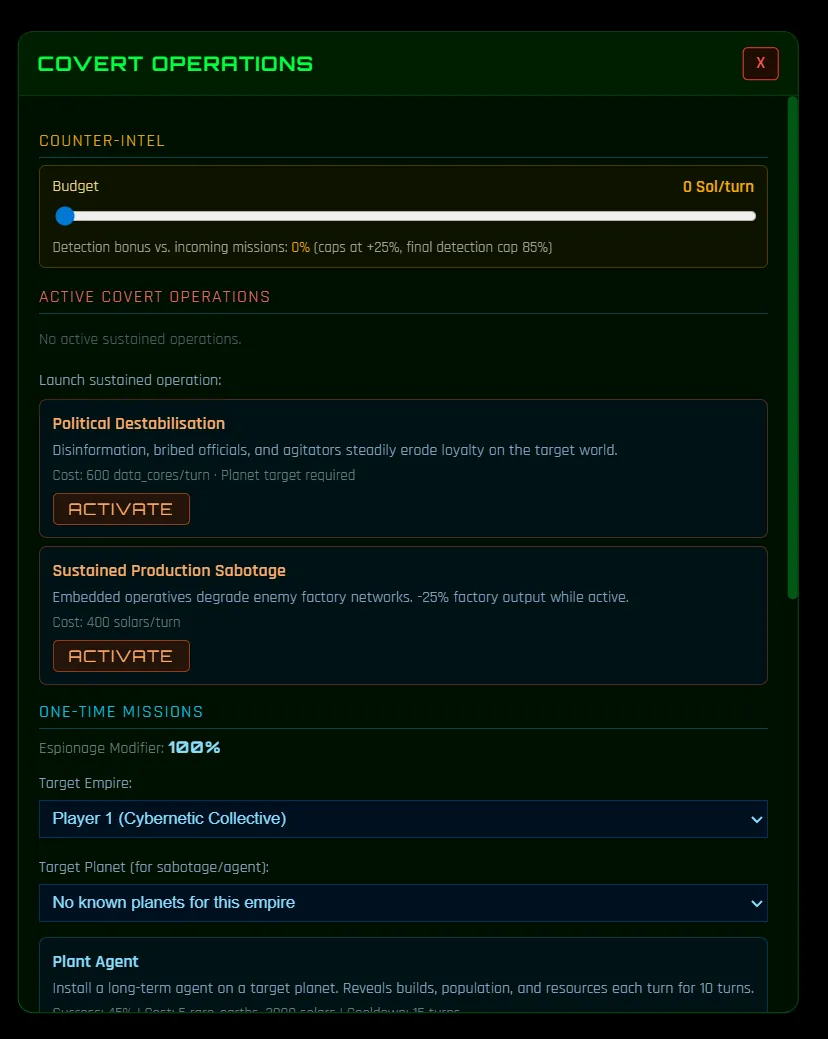
Espionage: agents, missions under way, and what your counter-intelligence has caught.
18. Story Events & Decision Cards
Two kinds of story run alongside the war.
Story events fire at the end of a turn: windfalls for your house, discoveries, planetary disasters, warnings of crisis, guardian encounters, rebellion cards and archaeology stages. Most are a card with two to four choices. The big ones are full-screen cinematics with original art, voice and video: Progenitor awakenings, planets cracked open, first contact, the fall of your empire.
Small events appear as notices in the corner of the screen without stopping you; anything important takes the full screen. Every event is recorded in your comms feed and turn summary.
Decision cards come with combat: short tactical choices about a battle that is coming or just ended. A Tactician captain gives you an extra card. Your officers' own cards are described in §7.6.
Turn results appear in a fixed order so nothing overlaps: diplomacy → combat → events → turn summary, with battle replays waiting until the screen is clear.
19. Territorial Influence
Every populated world projects influence into nearby space, growing with its population. The map draws your borders in your empire's color.
Inside your uncontested territory your ships fight harder (+10% damage, +15% shields) and your worlds produce more. Where an enemy's influence overlaps yours enough, the space is contested, and nobody gets these bonuses there. The Xenophobic Sovereignty's borders reach 50% farther, and their bonuses at home are doubled.
A contested border costs you income every turn it stays contested.
20. Victory, Golden Ages & the Endgame
20.1 How to win
The host chooses the victory paths when creating the game:
| Path | Condition | Default |
|---|---|---|
| Domination | Hold more than half of all colonized worlds (Short games: 40%). Worlds held by minor powers and other non-player factions do not count | On |
| Score | Have the highest score when the final turn is reached (Short 70, Standard 200, Epic 300) | On |
| Research | Take 3 of the 6 core disciplines to level 9+ (Short games: 7+) | On |
Score adds up your worlds, your fleet's combat strength (capped at 10 points per planet), your economy (population, mines and factories) and your technology, plus +40 for each core discipline at or above the research bar (7 in Short games, 9 otherwise). A strong economy wins on Score because it pays for the fleet and the research.
The Final Reckoning. The last 10 turns before the Score turn are announced in your comms feed, and a countdown with live standings appears on screen. This is the last chance to change the result.
The wealth podium. At the end, the three empires with the largest treasuries earn extra Score: +50 for the richest, +30 for second and +15 for third. A treasury under 1,000 Solars earns nothing. The podium can decide a close race but will not make up a large deficit.
The Research path is narrow. At level 9, only Hull, Beam and Engine can qualify, because the other lines stop sooner. In Short games the bar is 7, so Torpedo counts as well.
Minor powers and other non-player factions can never win.
20.2 Golden Ages
Each house has its own trigger (§2). Meeting it starts a 10-turn Golden Age: +20% mining and tax across your empire, a music cue and gold on the scoreboard. After it ends, another cannot begin for 20 turns. Only human commanders get Golden Ages.
Plan for yours. Ten turns of extra output, spent well, can decide a game.
20.3 The endgame
In Standard and Epic games, the galaxy does not stay quiet while you finish.
Past the halfway point the game stops being only about your neighbors. Crises begin: small and survivable at first, then less so. Plagues cross borders that fleets respect. Empires that spent forty turns building warships find out what the warships were for.
If the game runs long enough, something much older than any empire at the table takes an interest in whoever is winning. It does not keep a schedule you can plan around, and it does not go after the weakest player.
This manual will not say what it brings. You will hear from it first, then from your allies. When the time comes there will be a council, a choice about who sails and what they risk, and a battle that can be won. Breaking that threat is a victory of its own, even for an empire that does not win the game.
Short games have no final crisis.
AI empires can surrender. An AI that once held 4 or more worlds and is down to 2 or fewer, at war, with less than a quarter of its strongest enemy's warship strength for 3 turns in a row, surrenders its worlds and starbases to that enemy. Human commanders never surrender automatically.
21. Your Commander Profile
Your record follows you from game to game.
Claim a handle. In the lobby, open your profile and claim a unique handle of 3 to 24 characters. It gives you a public page at /commander/<your-handle> that anyone can read, signed in or not.
Your portrait comes from the Faction Forge companion app: create a portrait there, send it back to the game and frame it with the built-in cropper. You can also upload your own.
Your rank is cosmetic and rises with your career victories: Ensign → Lieutenant → Lt. Commander → Commander → Captain → Commodore → Fleet Legend.
Achievements come from your match history:
| Achievement | Earned by |
|---|---|
| Founding Commander | An account created before 1 September 2026 with at least one finished game |
| First Victory | Winning your first game |
| Warlord | Five victories |
| Veteran | Ten games finished |
| Overlord | Winning by Domination |
| Scientist | Winning by Research |
| Centurion | Playing a game past turn 100 |
| Galactic Polyglot | Finishing games with four different houses |
Your public page also shows your record by house, your battle history and your Known Rivals: the commanders you have played against and how you fared. Games in which your seat spent time under AI control are marked.
The Leaderboard ranks the highest-scoring victories ever recorded.
When a game ends, the Hall of Captains remembers every officer your empire raised, living and fallen, each with a title earned from their record.
21.1 Becoming an Admiral
Joining a game is always free, with no limit. Hosting is free too, at first: your first month of hosting costs nothing, one game at a time, and the month starts the day you host your first game. After that, hosting needs Admiral: $4.99 a month or $29.99 a year, which lets you host up to five games at once.
The limit of five keeps the turn server responsive for everyone. Finish or delete a game to start another.
The Commander's Edition (§1.5) includes four months of Admiral: automatically on Steam, or by entering your itch.io download key in the Admiral window.
22. UI Reference
22.1 Controls
| Input | Action |
|---|---|
| Left-click | Select a ship, planet or starbase |
| Right-click | Order the selected ship to move there (along the Axis lanes) |
| Shift + click | Force an Abyss jump: a straight line, heavy fuel use, hull damage |
| Scroll wheel | Zoom |
| Drag | Pan the map |
| Ctrl + A | Select all your ships |
| Ctrl + 1-9 | Put the selected ships in that fleet |
| 1-9 | Select that fleet |
| Tab / Shift + Tab | Cycle through your fleets |
| T | Open the turn summary |
| Esc | Close the top window |
22.2 Settings worth turning on
The Tactical menu holds the map overlays: Territory Borders, Fog of War, Supply Radius, Trade Routes, Sensor Range and the four resource-density overlays. The resource overlays show you where to send your scouts.
Turn on Empire shapes in Options and every empire gets its own symbol (▲ ◆ ● ■ ★ ✚ ✖ ◐) beside its planets and ships, so you never have to tell empires apart by color alone. It is off by default.
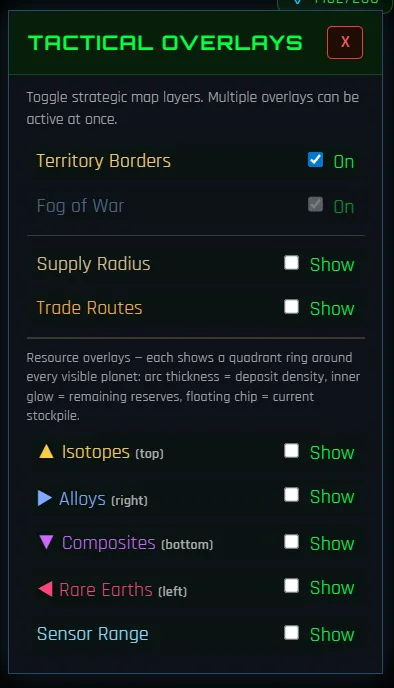
Tactical overlays show where the resources are.
22.3 Playing on a phone
The game works on a phone in portrait or landscape:
- The top bar shows its menus as icon buttons, with your resources underneath.
- A strip along the bottom keeps your turn, Solars and READY button in reach.
- The NAV tab on the left edge opens the navigation drawer. Picking a ship or world from it closes the drawer so you can see the map.
- Planet and ship panels fill the screen below the top bar; close them with the red ×.
- Pinch to zoom, drag to pan, and press and hold on a planet to make an Abyss jump.
- The combat replay supports pinch, drag, double-tap to reset and a ⤢ FIT button.
22.4 Install it
You can install Axis and Abyss as an app from your browser's menu ("Add to Home Screen" or "Install"). It then opens full-screen without the browser's address bar.
22.5 Your comms feed
SUBSPACE COMMS keeps the record: battles, construction, research, diplomacy, governor actions, story events and turn summaries. The turn summary opens on the Economy tab, which shows where every Solar came from and went. The 📜 Chronicle tab lists the whole game turn by turn; click any past turn to load it into the other tabs.
23. Glossary of the Shattered Axis
| Term | Meaning |
|---|---|
| The Axis | The Progenitor lane network: fast, cheap travel |
| The Abyss | The open space between the lanes. Crossable, slow and damaging |
| The Shattered Axis | This region of the galaxy, where the old lane network broke worst |
| The Oikumene | "The inhabited whole": the Progenitors' galaxy-wide civilization |
| The Silence | The disaster that ended the Oikumene and darkened the lanes |
| The Reawakening | Now: the lanes coming back to life after three thousand years |
| Wormhole | A paired corridor. About 13 times lane speed, very little fuel, only with your consent |
| Starbase | A world's shipyard, fortress and tech ceiling |
| Hub | Logistics Hub: produces Solars and Logistics |
| Post | Defense Post: planetary defense that fires in the opening salvo |
| Data Core | Research currency |
| Initiative | The order ships act in during combat, driven mostly by engine tech and low mass |
| First Strike | The defenders' opening salvo from stations and posts |
| Unrest | 0 to 100 on each world. At 100, the world rebels |
| Atrocity | A lasting stain on your empire from Iron Fist, Cleanse or the Planet Cracker |
| Free State | A world granted independence: friendly, and no longer yours |
| Guardian | A native people who defend their world until you satisfy them |
| Minor power | One of three small NPC empires that play the game but cannot win it |
| Golden Age | A 10-turn boost from your house's unique trigger |
| VCR | The battle replay viewer |
| NAP | Non-Aggression Pact: while it lasts, neither side can attack the other |
| Contested | Border space where an enemy's influence overlaps yours; no territorial bonuses apply |
| Overdrive | Running a drive above your engine tech. Costly in fuel from three tiers over |
| Final Reckoning | The last 10 turns before the Score victory, with a countdown on screen |
| Commander Profile | Your public record at /commander/<handle> |
| Muster | A standing order that gathers a fleet at one planet, then clears itself |
| Formation Row | Vanguard, Core or Long Range: sets the range a ship fights at within its fleet |
| Battle Plan | A one-click doctrine setting posture, tactic and range, with a small combat modifier |
| World Destroyer | A superweapon hull, named by each house, built after completing an Orbital Ring |
| Planet Cracker | The World Destroyer's weapon: a 5-turn countdown, then total destruction |
| Admiral | The hosting subscription: up to five games at once |
| Commander's Edition | The paid Steam and itch.io desktop build; free browser play is unchanged |
Credits
- Design & Art Direction: Corey Skinner
- Studio: Synprax Labs
- Engine: Python · Flask · PostgreSQL · HTML5 Canvas
- Art: Google Imagen and Higgsfield pipelines; ship, faction and captain art for every house
- Portraits: Faction Forge
- Music & Voice: faction scores and voiced narration
Build: Alpha 4.0 (Launch Edition) · Manual version: 3.2 · Last updated: 20 October 2026
"The silence is not permanent. Reach wisely."